Reflux treatment can affect thyroid treatment, but not every stomach medicine does it the same way.
That nuance matters. Patients often hear a flat warning about antacids and levothyroxine, then assume omeprazole, Tums, magnesium antacids, and every reflux product should all be handled identically. They should not.
Here is the short answer: Calcium-based antacids such as Tums should usually be kept at least 4 hours away from levothyroxine, while proton pump inhibitors such as omeprazole do not create the same simple clock-based conflict but can still change levothyroxine absorption enough to require closer monitoring.
This guide breaks down the difference between calcium antacids and acid-lowering medicines, explains what spacing rules actually matter, and shows when a reflux routine deserves a thyroid lab review.
The Quick Answer
| Situation | What it usually means | Better move |
|---|---|---|
| Tums or another calcium carbonate antacid taken near levothyroxine | This behaves like a calcium interaction and can lower absorption | Keep at least a 4-hour gap |
| Aluminum or magnesium antacid used in the same morning window | Absorption can still become less predictable | Move the antacid away from the levothyroxine dose and keep the thyroid routine simple |
| Omeprazole or another PPI started daily | The problem is less about the same-minute clock and more about stomach acid and absorption environment | Tell the clinician, keep the levothyroxine routine consistent, and recheck thyroid labs if control changes |

The reflux routine matters, but the product type matters even more
A calcium antacid behaves differently from a PPI, which is why the advice cannot be one-size-fits-all.
What should patients know about Levothyroxine and Antacids (Tums, Omeprazole)?
Patients often group every stomach medicine into one category, but the clinical question is really two questions. Is the product a mineral-containing antacid that can bind levothyroxine directly? Or is it an acid-lowering medicine that changes gastric conditions over time?
Tums matters because it contains calcium carbonate, which belongs in the same interaction family as calcium supplements. Omeprazole matters differently because it changes stomach acid and can make levothyroxine absorption less predictable in some patients even though separating the clock by a few minutes does not solve the whole issue.
That is why the right answer is not only, ‘Wait longer.’ Sometimes the right answer is, ‘Keep the thyroid routine consistent and watch the labs after the reflux treatment changes.’
What the FDA label and clinical guidance say
FDA prescribing information supports a 4-hour separation from calcium carbonate and other classic mineral blockers. That is the cleanest rule for products like Tums.
The bigger reflux-management literature also shows that acid-lowering states can change levothyroxine absorption. For some patients that means nothing dramatic. For others it explains why TSH drifts after a PPI or chronic reflux treatment begins.
The practical goal is not to stop reflux care. It is to recognize which product type you are taking and build the thyroid plan around that reality.
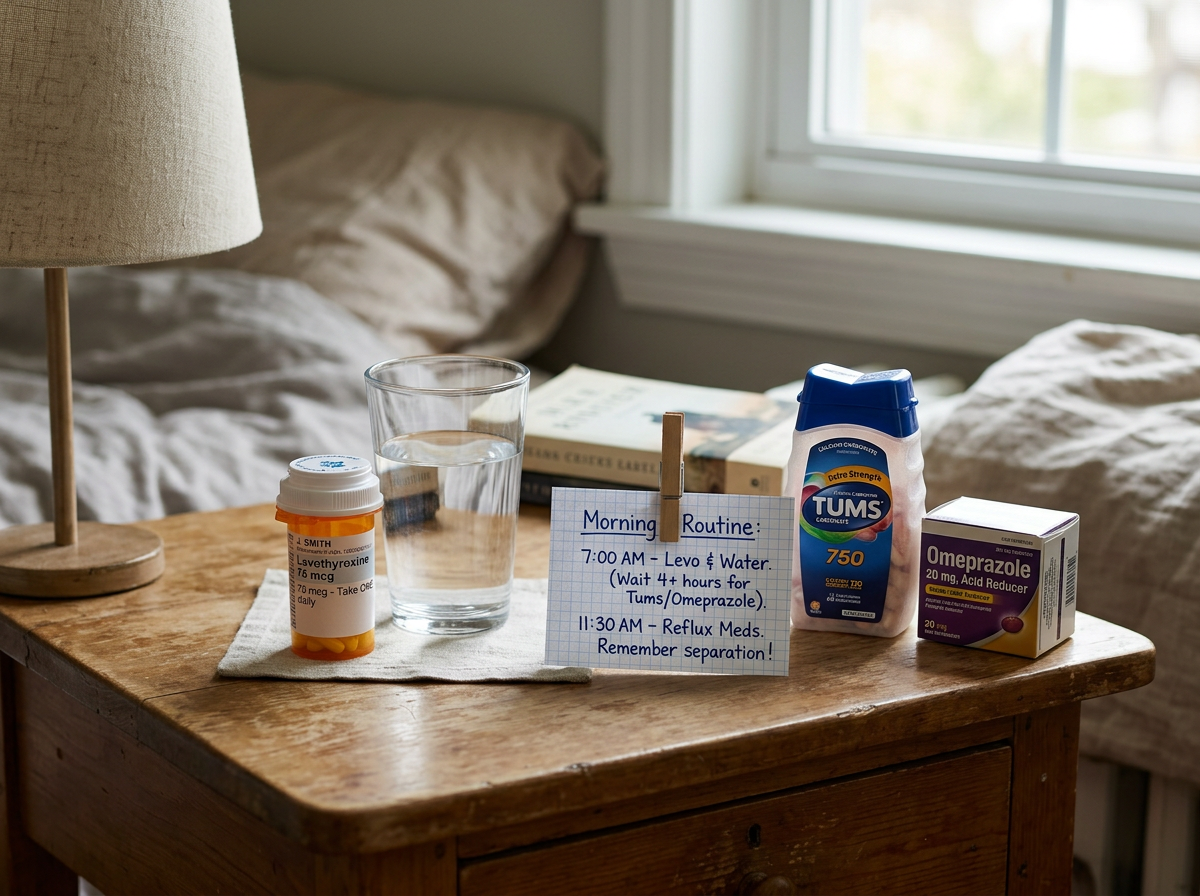
The question is not only when the pills are taken. It is also what kind of reflux medicine entered the plan
Tums and omeprazole can both matter, but they do not create the same kind of thyroid problem.
How the interaction happens
Calcium antacids create a direct binding-style problem. They sit in the same absorption window as levothyroxine and reduce how much of the thyroid medication gets absorbed.
Omeprazole and other proton pump inhibitors act differently. They lower gastric acid, which can alter how the levothyroxine tablet dissolves and how predictably it is absorbed over time. That means spacing the pills by a few extra minutes may not fully solve the issue.
This distinction matters because many patients chase the wrong fix. They keep moving omeprazole around the clock when the more important step is recognizing a changed absorption environment and following the thyroid labs after the reflux plan changes.
Timing and spacing rules that matter
The timing rule is straightforward for calcium antacids and more nuanced for acid-lowering medicines. That is the heart of this topic.
| Scenario | Why it matters | Practical routine |
|---|---|---|
| Tums or calcium carbonate antacid | Direct mineral-style interaction | Keep at least 4 hours between levothyroxine and the antacid |
| Aluminum or magnesium antacid | Can still crowd the absorption window | Move the antacid away from levothyroxine and avoid taking both as part of the same morning routine |
| Omeprazole or another daily PPI | Not a simple same-minute conflict | Take levothyroxine consistently on an empty stomach and review labs after the reflux treatment changes |
| Bedtime reflux routine with morning levothyroxine | Often easier to manage | If the reflux medicine can be taken later without changing effectiveness, that usually protects the thyroid window better |

Many unstable thyroid routines start with a correct reflux treatment and an incomplete schedule review
When the stomach plan changes, the thyroid plan often needs a fresh look too.
Common mistakes and troubleshooting
The usual mistakes happen because the stomach treatment and the thyroid treatment get mixed together into one generic category.
- Assuming Tums and omeprazole behave exactly the same way because both are used for reflux symptoms.
- Keeping a calcium antacid in the same morning routine as levothyroxine and breakfast.
- Starting a daily PPI, seeing the thyroid labs shift months later, and never connecting the two changes.
- Trying to solve a chronic omeprazole issue only with clock spacing when the larger question is whether the absorption environment changed enough to matter.
Special situations to remember
- Patients with chronic gastritis, atrophic gastritis, bariatric surgery history, or several absorption-sensitive medications deserve extra care because the routine may already be fragile before reflux therapy is added.
- If reflux is severe enough that antacids are used repeatedly through the day, the thyroid routine may need a broader medication review rather than a single timing tweak.

Persistent drift after reflux treatment changes deserves more than trial-and-error timing fixes
A targeted review can sort out whether the main issue is direct binding, lower stomach acid, or a crowded routine.
When to contact a healthcare provider
Most reflux-thyroid conflicts can be sorted out with schedule review and follow-up labs, but some patterns should not be handled by trial and error alone.
- TSH changed after starting or stopping a PPI and the drift has persisted.
- You need calcium antacids several times per day and cannot keep them away from the levothyroxine dose.
- Reflux treatment changed during pregnancy, after surgery, or in the setting of known absorption problems.
- You developed new hypothyroid symptoms or repeated thyroid dose changes without anyone reviewing the reflux plan.
Frequently Asked Questions
Can I take Tums with levothyroxine?
Not in the same window. Because Tums contains calcium carbonate, most patients should keep it at least 4 hours away from levothyroxine.
Does omeprazole have the same rule as Tums?
No. Omeprazole is more about a changed absorption environment than a simple same-minute mineral interaction, so the answer is closer monitoring and a stable routine rather than only a clock fix.
What about magnesium or aluminum antacids?
They can still interfere with absorption, so it is safer to keep them away from the levothyroxine dose rather than stacking everything into the same morning window.
If I need reflux treatment every day, should I stop levothyroxine?
No. The better move is usually to protect the thyroid routine, review the reflux medicine type, and follow the labs.
Why did my TSH change after starting omeprazole?
For some patients, lower stomach acid changes how predictably the tablet is absorbed. The lab change may reflect that new absorption environment rather than a sudden change in thyroid disease itself.
Would a different levothyroxine formulation help?
Sometimes a clinician may consider that when absorption problems keep recurring, but it should be a guided decision rather than a self-directed switch.
Key Takeaways
- Tums behaves like a calcium interaction and usually needs a 4-hour gap.
- Omeprazole is different: it can matter without creating the same simple clock-based problem.
- Not every antacid or reflux product should be managed the same way.
- If reflux therapy changed and thyroid labs drifted afterward, the schedule and medication type both deserve review.
Related Guides
- Levothyroxine Interactions: Complete FDA-Sourced Guide to Food, Drugs and Supplements
- Levothyroxine and the Empty Stomach Rule
- Best Time of Day to Take Levothyroxine
- Levothyroxine and Calcium Supplements
- Coffee and Levothyroxine: How Long to Wait
- Complete Drug Interaction Reference
Sources
- FDA. Levothyroxine sodium tablets prescribing information. https://www.accessdata.fda.gov/drugsatfda_docs/label/2023/021116s027lbl.pdf
- American Thyroid Association. Hypothyroidism booklet. https://thyroid.org/wp-content/uploads/patients/brochures/Hypothyroidism_web_booklet.pdf
- Virili C, et al. Levothyroxine therapy and gastric disorders. https://pubmed.ncbi.nlm.nih.gov/24406011/