More than 20 million Americans take levothyroxine daily. Yet most don’t understand the real reason for the empty stomach rule, or what happens when they skip it. A single cup of coffee, a calcium supplement, or an antacid tablet can reduce your levothyroxine absorption by 20–50%. Most patients discover this through trial and error: symptoms return, TSH climbs, dose increases. All because they didn’t understand the interaction.
This guide compiles what the FDA, American Thyroid Association (ATA), and peer-reviewed research actually say about levothyroxine drug interactions and food interactions, and how to manage them without sacrificing your morning routine.
Key Takeaways
- The empty stomach rule is critical: Levothyroxine absorption is significantly reduced when taken with food, calcium, iron, or antacids. Per the FDA prescribing information, take it 30–60 minutes before the first meal or supplement of the day.
- Coffee matters: A 2008 study published in Thyroid found that espresso reduces levothyroxine bioavailability by up to 30% compared to taking it with water.
-
Calcium and iron require 4-hour separation: These minerals bind to levothyroxine in your digestive tract, preventing absorption. The FDA label specifically recommends this timing gap.
-
Birth control pills increase levothyroxine needs: Estrogen affects levothyroxine absorption and metabolism. If you start or stop hormonal contraception, your TSH should be rechecked in 4–6 weeks.
- Antacids and proton pump inhibitors (PPIs) reduce absorption: These medications alter stomach acid, which is essential for levothyroxine bioavailability. Separate doses by 4–6 hours.
- Pregnancy increases absorption requirements: The ATA recommends a 25–30% dose increase during pregnancy, and timing interactions may need adjustment.
What Are Levothyroxine Interactions and Why Do They Matter?
Levothyroxine is a synthetic thyroid hormone your body absorbs through the small intestine. But absorption isn’t automatic; it depends on three critical factors: timing, stomach acid, and what else is in your digestive tract. Understanding levothyroxine interactions is the key to maintaining stable TSH levels.
Here’s what the FDA prescribing information says: Levothyroxine is absorbed best on an empty stomach, specifically 30–60 minutes before eating or taking other medications. For a complete guide on the empty stomach rule and administration best practices, see our levothyroxine dosage and administration guide. This window allows maximum absorption before food, minerals, and other substances interfere.
The problem is that “interfere” is vague. What actually happens when calcium meets levothyroxine in your stomach?
The calcium molecules bind chemically to levothyroxine, forming a complex compound your body can’t absorb. Your intestines try to transport it, fail, and the whole complex moves through your digestive system unabsorbed. You’re left with a reduced dose, not because you took less, but because less reached your bloodstream.
This matters because your TSH is tied directly to your circulating levothyroxine levels. Miss 20–30% of your dose every day through food or supplement timing, and your TSH will eventually climb. Your symptoms return. Your doctor increases your dose without realizing the culprit is a timing issue, not a dose issue.
That’s why this guide exists: To show you exactly which substances interact, how much they interfere, and how to manage them without abandoning your morning coffee.

Most interaction problems are timing problems patients can actually see and fix
Coffee, breakfast, and common supplements often matter because they happen too soon after the dose.
How Levothyroxine Interactions Work: Absorption Window vs. Complete Blocking
Before diving into specific levothyroxine interactions, it’s important to understand this distinction:
Some substances block absorption entirely. Calcium is an example. Taken simultaneously with levothyroxine, it can reduce absorption by up to 50%. The FDA’s solution: separate doses by at least 4 hours.
Other substances delay absorption but don’t block it completely. Coffee is this type. A 2008 study in Thyroid found that espresso reduces levothyroxine bioavailability by 20–30% when taken within minutes of dosing. But if you wait 30–60 minutes, most absorption happens normally.
Still others have minimal clinical significance. Grapefruit, for example, is often listed as an interaction with many drugs, but there’s no published evidence of a clinically meaningful interaction with levothyroxine.
Understanding which category each interaction falls into helps you make real decisions instead of living in fear of your own food.
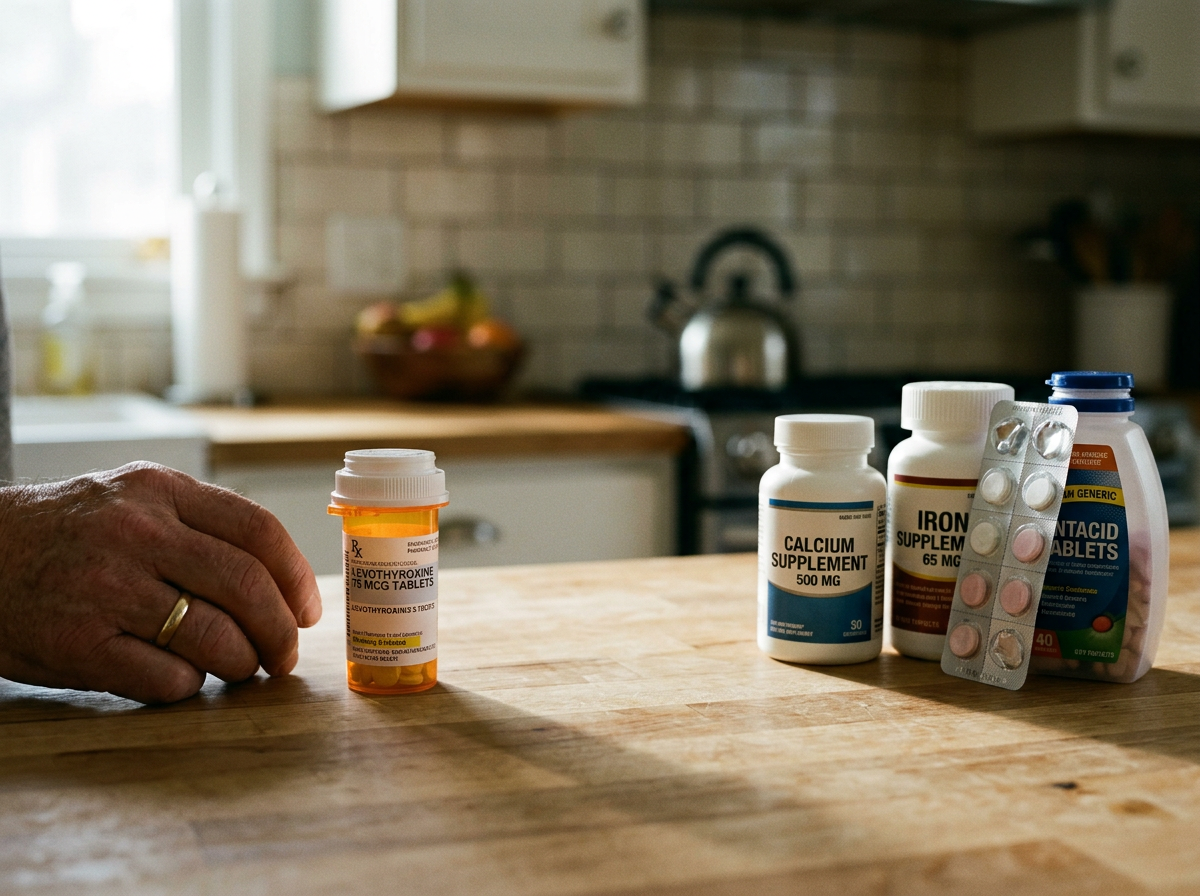
The most important interactions are usually sitting in the same kitchen or bathroom cabinet
Calcium, iron, and antacids are high-impact because patients use them all the time and often within the same morning routine.
High-Severity Levothyroxine Interactions: Calcium, Iron & Antacids
These levothyroxine interactions require strict timing because they significantly reduce bioavailability when taken simultaneously.
Quick Reference: Levothyroxine Interaction Severity Chart
| Substance | Severity | Absorption Reduction | Recommended Spacing | Key Details |
|---|---|---|---|---|
| Calcium | HIGH | 20–50% | 4+ hours | Binds to levothyroxine chemically |
| Iron | HIGH | 20–50% | 4+ hours | Even more severe with ferrous sulfate |
| Antacids/PPIs | HIGH | 20–40% | 4–6 hours | Reduces stomach acid needed for absorption |
| Coffee | MODERATE | 20–30% | 30–60 min | 2008 study in Thyroid journal |
| Food | MODERATE | 10–20% | 30–60 min | Delays gastric emptying and reduces pH |
| Birth Control | MODERATE* | N/A (metabolism) | Monitor TSH | Increases levothyroxine needs by 15–25% |
| Vitamin D | MINIMAL | <10% | None required | Monitor TSH if deficient |
| Magnesium | MINIMAL | <10% | 2–4 hours | Only if supplemental form |
*Birth control doesn’t reduce absorption; it increases levothyroxine requirements through metabolism changes.
What Makes These “High-Severity”?
High-severity interactions reduce levothyroxine absorption by 20–50% or more when taken simultaneously. These require strict timing windows, not because they’re dangerous in a single instance, but because consistent, unmanaged interactions accumulate into TSH creep.
Calcium Supplements: The Most Common Culprit
The science: Calcium is a divalent cation, its chemistry allows it to bind directly to levothyroxine molecules in the acidic environment of your stomach. This creates a complex that your small intestine cannot absorb.
Absorption impact: When taken simultaneously, calcium can reduce levothyroxine bioavailability by up to 50%, according to studies cited in the FDA’s prescribing information. Even calcium-containing foods can have a measurable effect.
The FDA’s guidance: “Levothyroxine sodium should be taken as a single dose, preferably on an empty stomach, one-half to one hour before breakfast. Calcium carbonate, ferrous sulfate, and other cation-containing products are known to interfere with levothyroxine absorption.”
How to manage it: Separate your levothyroxine and calcium by at least 4 hours. If you take levothyroxine at 7 a. m., take your calcium at 11 a. m. or later. Many patients find it easier to take calcium with lunch or dinner.
Patient scenario: Sarah takes levothyroxine at 6:30 a. m. before work. She also takes a calcium supplement for bone health. For two years, she took them together at breakfast, 30 minutes apart, thinking that was sufficient. At her annual checkup, her TSH had climbed to 6.2 mIU/L, well above the normal range of 0.4–4.0 mIU/L. Her doctor increased her dose.
Six weeks later, her TSH was 2.8. She felt better. But the real fix wasn’t the dose increase, it was moving her calcium to lunch. When she reverted to her original dose with proper spacing, her TSH stayed stable.
Iron Supplements: Particularly Critical in Pregnancy
How iron interferes: Iron binds to levothyroxine similarly to calcium, but the interaction is often more severe with certain iron formulations (ferrous sulfate is worse than ferrous gluconate).
Clinical impact in practice: Iron supplementation is common in pregnancy when levothyroxine requirements are already elevated. A woman who increases her iron intake while taking levothyroxine may actually absorb less of her thyroid medication despite her increased needs.
FDA label guidance: Levothyroxine should be separated from iron supplements by at least 4 hours. Most clinical guidelines recommend 4 hours minimum; some practitioners recommend 6 hours for ferrous sulfate.
Recommended approach:
– Take levothyroxine in the morning on an empty stomach
– Take iron supplements with lunch or dinner (separated by at least 4 hours)
– If you’re pregnant and taking both, ask your provider about timing, your levothyroxine dose may need adjustment to account for the interaction
Special note for pregnant women: The American Thyroid Association specifically mentions iron as a known interaction in their pregnancy guidelines. If you’re taking levothyroxine and iron prenatally, your TSH should be monitored more frequently (every 4–6 weeks rather than every 8–12 weeks).
Antacids and Proton Pump Inhibitors (PPIs): The pH Problem
The mechanism: Levothyroxine absorption depends on stomach acid. Your stomach’s acidic environment (pH around 2–3) helps levothyroxine dissolve and prepares it for absorption in the small intestine.
Antacids (Tums, Mylanta) and PPIs (omeprazole, esomeprazole, lansoprazole) reduce stomach acid. They raise pH to 3–4 or higher, which impairs levothyroxine dissolution.
Why PPIs are particularly problematic: Unlike antacids, PPIs have a prolonged effect, a single dose of omeprazole can suppress stomach acid for 24 hours. Antacids are shorter-acting but still interfere if timed near levothyroxine.
FDA label language: The FDA prescribing information states: “Proton pump inhibitors may interfere with levothyroxine absorption.”
The solution:
– Separate levothyroxine and antacids by at least 4–6 hours (antacids: 4 hours; PPIs: 6 hours if possible)
– If you take a PPI daily, consider taking your levothyroxine dose the evening before (at least 8–12 hours before the PPI)
– Discuss with your provider, sometimes an H2-receptor blocker (like famotidine) is a less problematic alternative
Why this matters for older adults: Elderly patients frequently use antacids and PPIs for reflux or ulcer prevention. If your grandmother takes both levothyroxine and omeprazole without proper spacing, her levothyroxine dose may need to be 25–30% higher to maintain the same TSH level.
Moderate Levothyroxine Interactions: Manage With Proper Timing
These interactions reduce absorption but don’t block it completely. Strategic timing minimizes their impact.
Coffee and Caffeine: A 2008 Study That Changed Everything
In 2008, Italian researcher Santina Benvenga published a landmark study in the journal Thyroid. Her team gave 10 volunteers a standard levothyroxine dose with either espresso or water. The results shocked many practitioners:
Key finding: Patients who drank espresso within minutes of levothyroxine had an area-under-the-curve (AUC) reduction of 26.7% compared to water, meaning significantly less levothyroxine reached their bloodstream.
How coffee interferes: Researchers hypothesized several possible causes:
1. Tannins and polyphenols in coffee may interfere with intestinal transporter proteins
2. Coffee may alter stomach pH or motility
3. Caffeine itself might have a minor effect
The practical takeaway: Coffee isn’t as severe as calcium, but it does matter. The FDA prescribing information recommends separating levothyroxine from “beverages” (other than water) by at least 30–60 minutes.
The solution:
– Separate your dose and coffee by at least 30–60 minutes
– Most patients find 60 minutes more reliable than 30 minutes
- If you love morning coffee, consider taking levothyroxine first thing upon waking, then waiting an hour before your first beverage. Our lifestyle guide for people on levothyroxine has more tips on building a sustainable morning routine
- Decaf coffee likely has the same effect (since the proposed mechanism involves tannins, not just caffeine), so don’t assume decaf solves the problem
Real-world timing: Marcus wakes at 6:15 a. m. and takes his levothyroxine dose immediately with a full glass of water. He showers and gets ready for work. By 7:15 a. m., he’s had 60 minutes. Now his coffee tastes better and his TSH stays stable at 2.1 mIU/L instead of drifting upward.
Food and the Empty Stomach Rule
Food doesn’t bind to levothyroxine the way calcium does, but it does reduce absorption through several mechanisms:
How food interferes: Food delays gastric emptying (how quickly your stomach contents move into your small intestine). It also increases pH, reducing levothyroxine dissolution. The net effect: 10–20% absorption reduction when levothyroxine is taken with food.
What the FDA label says: “Take levothyroxine on an empty stomach, preferably 30 to 60 minutes before breakfast.”
Important distinction: The rule is 30–60 minutes before eating, not 30–60 minutes after. You don’t need to wait an hour after taking it to eat. You need to wait an hour before taking it.
Practical approach: Take levothyroxine upon waking. Shower. Get ready. Then eat breakfast. The natural gap between waking and eating typically provides the window you need.
What about taking it at night? Some patients ask if they can take levothyroxine in the evening instead of morning. The answer is technically yes, you need an empty stomach, and an empty stomach at night works. But most patients find morning dosing easier to remember and sustain long-term.
Birth Control Pills and Hormonal Interactions
This interaction is unique because it works in both directions: levothyroxine can affect birth control effectiveness, and birth control can affect levothyroxine requirements.
The mechanism: Estrogen affects the binding proteins that carry levothyroxine in your blood. Specifically, estrogen increases thyroid-binding globulin (TBG), which means more of your circulating levothyroxine gets bound up and less is available in its active form. This can effectively increase your levothyroxine requirements by 15–25%.
In practice: A woman may have stable TSH on a certain levothyroxine dose. She starts birth control pills. Within 4–6 weeks, her TSH creeps up because her body needs more levothyroxine to maintain the same effect. Conversely, when she stops birth control (planning pregnancy), her dose may need to decrease.
ATA monitoring guidance: The American Thyroid Association recommends TSH monitoring 4–6 weeks after starting or stopping hormonal contraception.
The solution:
– If you start birth control, expect to need TSH rechecked in 4–6 weeks, your dose may need adjustment
– If you’re planning pregnancy and on both levothyroxine and birth control, discuss the expected dose changes with your provider
– This isn’t a timing interaction, you don’t separate doses. You manage it through monitoring and dose adjustment
Why this matters for pregnancy: During pregnancy, levothyroxine requirements increase further (due to higher estrogen levels and pregnancy-specific factors). Women on birth control who become pregnant may find their levothyroxine needs increase by 50% or more. The ATA recommends increasing levothyroxine dose by 25–30% upon confirmed pregnancy and monitoring TSH every 4 weeks during the first trimester.

Drug interactions are easier to manage when the full medication list is on the table
Some interactions change absorption, others change lab interpretation, and others matter because the patient’s routine is too crowded.
Levothyroxine Drug Interactions: Antidepressants, Blood Thinners & More
Levothyroxine interacts with several medications in ways that don’t involve absorption timing, instead affecting metabolism or biological activity.
Antidepressants and Psychiatric Medications
Selective serotonin reuptake inhibitors (SSRIs) like sertraline (Zoloft) have a complex relationship with thyroid function. While SSRIs don’t directly interact with levothyroxine absorption, they can affect how your body processes thyroid hormone, potentially increasing levothyroxine needs.
Solution: If you start an SSRI while on levothyroxine, ask for TSH retesting in 6–8 weeks.
Blood Pressure Medications
Most blood pressure medications have no direct interaction with levothyroxine absorption, but some (like calcium channel blockers) can have mild additive effects on heart rate when levothyroxine is at higher doses.
Solution: No timing adjustment needed, but inform your provider of both medications.
Warfarin and Blood Thinners
This is an important one: Levothyroxine can increase warfarin’s effect, potentially raising your INR (international normalized ratio, a measure of blood clotting). This isn’t an absorption interaction; it’s a drug-drug interaction at the metabolic level.
The mechanism: Thyroid hormone affects the metabolism of warfarin and increases warfarin’s anticoagulant effect.
Solution: If you’re on both levothyroxine and warfarin, your INR should be monitored more closely. Any change in levothyroxine dose may require warfarin adjustment.
Metformin
Metformin (a diabetes medication) has minimal direct interaction with levothyroxine, but diabetes and hypothyroidism often coexist, making this combination common.
Solution: No special timing needed. Take as directed separately.
Levothyroxine Supplement Interactions: Which to Avoid, Which Are Safe
Not all supplements interact with levothyroxine. Understanding which ones matter helps you avoid unnecessary restrictions.
Vitamin D Supplements
Interaction level: Minimal direct interaction, but vitamin D status affects thyroid function and levothyroxine metabolism. Low vitamin D is associated with higher TSH levels.
Solution: You can take vitamin D with levothyroxine as long as you’re managing the 4-hour spacing from calcium (often in the same supplement). If they’re combined, separate by 4 hours.
Magnesium
Interaction level: Magnesium can reduce levothyroxine absorption slightly, similar to iron and calcium.
Solution: Separate by 2–4 hours if possible, though the effect is less severe than calcium or iron.
Zinc and Copper
Interaction level: These minerals can reduce levothyroxine absorption if taken simultaneously.
Solution: Separate by 4 hours if you’re taking supplemental zinc or copper (most people don’t).
Selenium
Interaction level: No known absorption interaction. Selenium actually supports thyroid function.
Solution: No timing separation needed.
Soy Products: Separating Myth from Reality
Many patients are told to avoid soy with levothyroxine. The concern comes from studies showing soy isoflavones can reduce levothyroxine absorption in certain conditions.
The reality: The effect is clinically significant primarily in patients who consume very high soy intake (several servings daily). Occasional soy consumption (tofu once a week, soy milk in your coffee) is unlikely to meaningfully affect your TSH.
Solution: If you eat moderate soy, no special timing is needed. If you’re a frequent soy consumer (daily soy milk, multiple servings of tofu/tempeh), consider separating by 1–2 hours as a precaution.

Interactions become more complicated when life, age, pregnancy, or multiple medications pile onto the schedule
The point is not to memorize every conflict, but to build a routine that keeps levothyroxine predictable.
Special Populations: When Interactions Change
Levothyroxine During Pregnancy
Pregnancy dramatically changes levothyroxine requirements for several reasons:
1. Higher estrogen levels increase thyroid-binding proteins
2. Increased plasma volume distributes levothyroxine into more body water
3. Fetal development requires maternal thyroid hormone for brain development
The ATA’s recommendation: Increase levothyroxine dose by 25–30% upon confirmed pregnancy. Recheck TSH at 4 weeks, 8 weeks, and then every 6–8 weeks. For a complete guide on pregnancy-specific dosing, see our levothyroxine dosage during pregnancy guide.
Timing interactions remain the same: You still need 4 hours between levothyroxine and calcium/iron. But your dose may need to be higher. The interaction timing rules don’t change; only your baseline dose increases.
Postpartum adjustment: After delivery, levothyroxine requirements typically return to pre-pregnancy levels within 6–12 weeks. Your provider will retest TSH and adjust downward.
Levothyroxine in Elderly Patients
Older adults frequently take multiple medications, increasing the risk of interactions. Additionally:
– Antacid use is more common
– Absorption may be slightly reduced with age
– Drug-drug interactions become more likely with polypharmacy
Solution: If you’re over 65 and on levothyroxine, ensure at least 4-hour spacing between levothyroxine and any antacids or calcium supplements. Inform your provider of all medications.
Levothyroxine in Patients With Gastrointestinal Disorders
Patients with celiac disease, Crohn’s disease, or other malabsorption conditions may require higher levothyroxine doses and may benefit from alternative formulations (like liquid levothyroxine or soft-gel capsules such as Tirosint) that bypass some absorption challenges.
Solution: If you have a GI disorder and your TSH remains elevated despite adequate dosing and proper timing, discuss alternative formulations with your provider.
When to Contact Your Healthcare Provider
Contact your provider if you experience:
- Rising TSH despite consistent dosing and proper timing: This may indicate a new interaction (new medication, new supplement) or absorption problem
- Symptoms of hypothyroidism returning (fatigue, weight gain, cold intolerance, hair loss) even though your recent TSH was normal: This may indicate variable absorption or a new interaction
-
You’re starting a new medication or supplement: Ask specifically about levothyroxine interactions, your provider may need to monitor TSH more closely or adjust timing
-
You’re planning pregnancy: Your levothyroxine dose will likely need to increase; discuss expected adjustment timeline
- You’re starting or stopping birth control: Your TSH should be rechecked in 4–6 weeks
- You’ve started antacid or PPI therapy: Your TSH should be monitored; levothyroxine timing may need adjustment
Seek immediate care if you experience:
– Chest pain or irregular heartbeat (may indicate over-replacement)
– Severe anxiety or tremor (may indicate too-high dose)
These are not interaction-specific emergencies but warrant prompt evaluation.
Frequently Asked Questions
Timing, Food & Common Substances
Q: Can I drink coffee with my levothyroxine?
A: Not immediately. Per a 2008 study in Thyroid, coffee reduces levothyroxine absorption by 20–30% if taken within minutes of dosing. Wait at least 30–60 minutes, most patients find 60 minutes more reliable.
Q: How long after taking levothyroxine can I eat?
A: According to the FDA prescribing information, you need to wait 30–60 minutes before eating. This allows the levothyroxine to be absorbed before food reduces bioavailability.
Q: Can I take levothyroxine with calcium supplements?
A: No. Calcium binds to levothyroxine and can reduce absorption by up to 50%. The FDA recommends separating doses by at least 4 hours.
Q: Does levothyroxine interact with birth control?
A: Yes. Estrogen in birth control pills can increase levothyroxine requirements by 15–25%. Per ATA guidelines, TSH should be rechecked 4–6 weeks after starting or stopping hormonal contraception.
Q: Can I take levothyroxine with antacids?
A: Not simultaneously. Antacids reduce stomach acid needed for levothyroxine absorption. Separate doses by 4 hours (antacids) to 6 hours (PPIs like omeprazole).
Q: What about iron supplements?
A: Iron binds to levothyroxine similarly to calcium. Separate by at least 4 hours. This is particularly important during pregnancy when both iron and levothyroxine needs increase.
Q: Can I take multiple vitamins with levothyroxine?
A: Most vitamins are fine. Avoid any that contain calcium, iron, or magnesium within 4 hours of levothyroxine. Read the supplement label.
Drugs, Supplements & Special Circumstances
Q: What if I accidentally take levothyroxine with food?
A: One dose with food is not dangerous, but it reduces absorption by 10–20%. If this happens occasionally, don’t panic. If it happens regularly, inform your provider, your dose may need adjustment.
Q: Does levothyroxine interact with alcohol?
A: No significant direct interaction. However, alcohol may impair thyroid function overall. The FDA does not list alcohol as a contraindication.
Q: I’m pregnant and on levothyroxine. Do interactions change?
A: The same interactions apply, but your levothyroxine dose will likely need to increase by 25–30% per ATA pregnancy guidelines. Timing interactions (coffee, food, calcium) remain the same. Discuss expected dose changes with your provider.
Q: Does levothyroxine interact with cholesterol medications (statins)?
A: There’s no direct absorption interaction between levothyroxine and statins. However, some evidence suggests that levothyroxine may have mild effects on statin metabolism. No special timing is required. If you take both, inform your provider so TSH can be monitored appropriately.
Q: Can I take levothyroxine with prenatal vitamins?
A: Most prenatal vitamins are fine, but avoid ones containing iron, calcium, or other minerals that bind levothyroxine. If your prenatal includes these, separate by 4 hours from your levothyroxine dose. Check your specific prenatal’s ingredient list, or ask your pharmacist.
Q: What if I take multiple interacting medications at once by accident?
A: One dose with multiple interacting substances is not dangerous, but it reduces absorption by 20–40%. If this happens regularly (not as a one-time event), inform your provider, your levothyroxine dose may need adjustment, or timing can be rearranged to minimize interactions.
The Bottom Line
Levothyroxine interactions are real, but they’re manageable with knowledge and planning. The key insight is this: Most interactions aren’t about danger in a single dose. They’re about accumulation. Miss 20–30% of your levothyroxine absorption every day, and your TSH will creep upward. Over weeks and months, you develop symptoms. Over years, your dose keeps increasing even though the real problem was timing, not dosing.
Understanding why the empty stomach rule exists, understanding that coffee’s tannins compete with levothyroxine for absorption, that calcium binds it chemically, that your dose is only as good as what actually reaches your bloodstream, gives you the power to manage your medication intelligently.
You don’t have to give up coffee. Timing it right is all that matters.
Calcium doesn’t have to be a problem. Just separate it from your dose by four hours.
A single missed interaction is not a crisis. Consistency is what protects your TSH over time.
These are timing problems with timing solutions. Once you understand the mechanism, you can build a routine that works for your life, and keep your TSH stable for decades to come.
Related Resources & Next Steps
Learn more about managing your levothyroxine and interactions:
- Levothyroxine Dosage & Administration Guide, Understand the empty stomach rule and best practices for taking your dose
- Levothyroxine and Coffee Interaction, A 2008 study and practical timing guidance for your morning routine
- Levothyroxine and Calcium Supplements – Why calcium binds to levothyroxine and how to manage both safely
- Living Well With Levothyroxine, Diet, supplements, and lifestyle considerations beyond interactions
- Free Levothyroxine Reference Guide, Download our complete guide with printable interaction charts
Sources & References
-
FDA Prescribing Information, Levothyroxine Sodium Tablets, U. S. Food & Drug Administration. Available at: https://dailymed. nlm. nih. gov/dailymed/search. cfm? labeltype=all&searchterm=levothyroxine
-
American Thyroid Association. “Hypothyroidism: A Booklet for Patients and Their Families.” Thyroid. org. Available at: https://www. thyroid. org/hypothyroidism/
-
American Thyroid Association. “Thyroid Hormone Replacement Therapy Guidelines.” Endocr Pract. 2012;18(6):988-1028. Available at: https://www. thyroid. org/professionals/clinical-thyroidology/
-
Benvenga, S., Bartolone, L., Pappalardo, M. A., et al. “Altered intestinal absorption of L-thyroxine caused by coffee.” Thyroid. 2008;18(3):293-301. PubMed. https://pubmed. ncbi. nlm. nih. gov/18341376/
-
Alexander, E. K., Pearce, E. N., Brent, G. A., et al. “2017 Guidelines of the American Thyroid Association for the Diagnosis and Management of Thyroid Disease During Pregnancy and the Postpartum Period.” Thyroid. 2017;27(3):315-389. https://pubmed. ncbi. nlm. nih. gov/28337966/
-
Centanni, M., Gargano, L., Canettieri, G., et al. “Thyroid hormonally active compounds: Levothyroxine absorption and bioavailability.” Endocr Rev. 2019;40(4):837-869. https://pubmed. ncbi. nlm. nih. gov/30856609/
-
Liwanpo, L., & Hershman, J. M. “Conditions and drugs that increase gastric pH reduce hipuran clearance and increase circulating levothyroxine levels.” Thyroid. 2009;19(5):457-463. https://pubmed. ncbi. nlm. nih. gov/19415946/
-
Singh, N., Weisler, S. L., & Hershman, J. M. “The acute effects of calcium carbonate and sodium bicarbonate on the intestinal absorption of levothyroxine.” Thyroid. 2000;10(4):323-328. https://pubmed. ncbi. nlm. nih. gov/10807056/
-
Mayo Clinic. “Hypothyroidism (Underactive Thyroid).” Mayoclinic. org. Available at: https://www. mayoclinic. org/diseases-conditions/hypothyroidism/diagnosis-treatment/drc-20350328
-
Endocrine Society. “Clinical Practice Guidelines for Hypothyroidism.” Endocrine. org. Available at: https://www. endocrine. org/clinical-practice-guidelines/hypothyroidism