This is one of the most confusing thyroid medication questions because the answer is not the usual supplement-spacing answer.
Patients with diabetes or insulin resistance often take both medicines. Then a TSH result shifts and everyone wants to know whether metformin blocked levothyroxine, improved it, or made the lab misleading. The honest answer is more nuanced.
Here is the short answer: Metformin is not one of the classic major blockers of levothyroxine absorption, but it can change TSH in some patients, which makes thyroid lab interpretation more complicated after metformin is started or adjusted.
This guide explains what is known about metformin and TSH, what is not proven, and how to avoid making fast thyroid dose changes on the basis of one confusing lab result.
The Quick Answer
| Situation | What it usually means | Better move |
|---|---|---|
| Metformin was started and TSH changed | The shift may reflect metformin-related TSH effects rather than a simple absorption failure | Keep the levothyroxine routine stable and review TSH together with free T4 and symptoms |
| You take both medicines every day | This is common and usually manageable | The main priority is consistent routines and planned follow-up rather than a 4-hour spacing rule |
| A clinician is thinking about changing the thyroid dose after one lab | Context matters on this interaction | Look at the whole picture before assuming metformin means the dose must change immediately |

This interaction is common because the two conditions often travel together
The challenge is usually interpretation, not a simple rule about keeping the bottles apart all day.
What should patients know about Levothyroxine and Metformin?
Metformin and levothyroxine often travel together because hypothyroidism, insulin resistance, polycystic ovary syndrome, and type 2 diabetes frequently overlap in the same patient. That alone makes this topic clinically important.
The key difference from calcium, iron, or coffee is that metformin has not been shown to suppress TSH simply by increasing levothyroxine absorption. Research suggests the effect is more likely to involve the hypothalamic-pituitary-thyroid axis or broader thyroid regulation.
For patients, the practical message is simple: do not assume a metformin-related TSH change always means the levothyroxine dose suddenly became wrong. It may, but it needs interpretation rather than reflex correction.
What the FDA label and clinical guidance say
One important PubMed study specifically looked at whether metformin lowered TSH by increasing levothyroxine absorption and found that this mechanism was not supported. That matters because it pushes the conversation away from unnecessary spacing rules.
At the same time, other studies have shown that TSH can fall in some patients after metformin starts. That means the labs can shift even when the levothyroxine routine itself did not become less reliable.
The safest approach is not to ignore the change and not to overreact to it. It is to interpret TSH together with free T4, symptoms, and the timing of the metformin change.
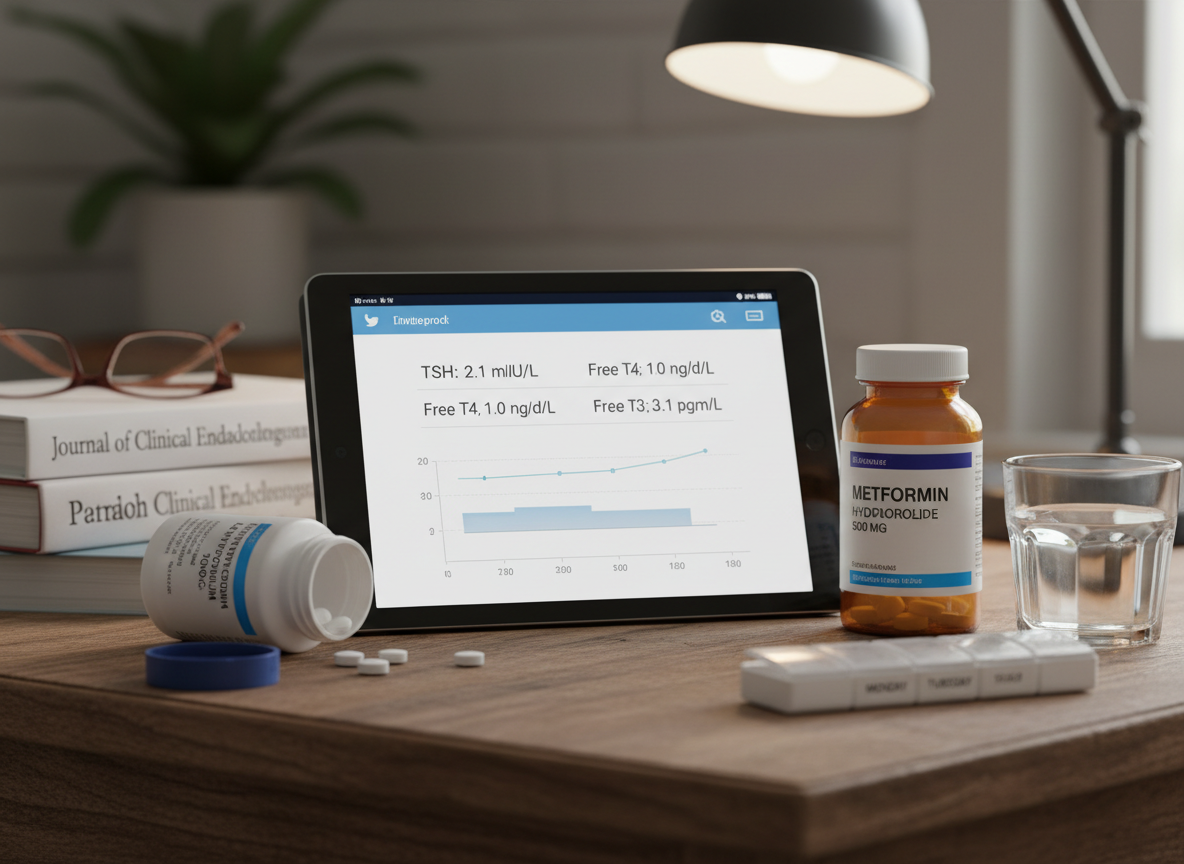
The question is often what the lab means, not whether the two medicines should ever coexist
Metformin can complicate the reading of thyroid tests without behaving like calcium or iron.
How the interaction happens
Metformin does not appear to behave like a classic gut-binding blocker. Instead, the leading concern is that it can affect TSH regulation in some patients, particularly those with hypothyroidism or insulin resistance, without a straightforward change in levothyroxine absorption.
That creates the clinical problem: a lower or different TSH can look as if the thyroid dose needs to change, even when the body did not necessarily receive more levothyroxine than before.
This is why metformin belongs in the lab-interpretation bucket of levothyroxine interactions rather than the pure spacing bucket.
Timing and spacing rules that matter
For most patients, the best practical rule is not ‘separate by 4 hours.’ The better rule is ‘keep both routines consistent and interpret follow-up labs carefully after metformin changes.’
| Scenario | Why it matters | Practical routine |
|---|---|---|
| Morning levothyroxine and metformin later with breakfast | Often easiest because metformin is commonly taken with food | Keep levothyroxine alone with water and take metformin the way it was prescribed |
| Both medicines taken every day but symptoms unchanged | A lab shift may still need context | Review TSH together with free T4 and symptoms before changing the dose |
| Metformin was increased or restarted | This is the moment when thyroid labs can become harder to interpret | Document the timing of the change and use it when reading the next thyroid panel |
| Extended-release metformin at dinner | Often reduces morning crowding | A consistent plan is usually more important than forcing both medicines into the same window |

The safest response to a new lab result is usually interpretation before dose escalation
A thoughtful review can prevent thyroid dose changes that are bigger or faster than the situation really requires.
Common mistakes and troubleshooting
The biggest mistakes happen when metformin is handled like a mineral interaction even though the physiology is different.
- Creating unnecessary spacing rules that make the whole routine harder without solving the real issue.
- Changing the levothyroxine dose too fast after one TSH shift without checking free T4 or looking at symptoms.
- Ignoring the fact that metformin itself may be part of the explanation when the lab picture changes after it is started.
- Assuming a lower TSH always means the patient is overtreated when the clinical picture does not match.
Special situations to remember
- This issue can be especially important in patients with thyroid cancer suppression goals, subclinical hypothyroidism, PCOS, or long-standing diabetes because the treatment targets may already be narrow or debated.
- If metformin, weight loss, and a levothyroxine brand change all happened around the same time, the lab interpretation becomes even more context-dependent.

When several conditions move at once, the thyroid plan needs a more deliberate review
Context matters most when the patient is managing more than one long-term endocrine problem at the same time.
When to contact a healthcare provider
Most patients can manage both medicines safely, but the follow-up needs to be more deliberate when the thyroid numbers become confusing.
- TSH changed after metformin was started or increased and the symptoms do not match the lab result clearly.
- You have thyroid cancer suppression therapy or another reason the TSH target is intentionally narrow.
- The clinician is considering a substantial levothyroxine change after one metformin-related lab shift.
- Weight, appetite, menstrual pattern, and thyroid symptoms all changed together after starting treatment and the picture is hard to interpret.
Frequently Asked Questions
Does metformin block levothyroxine absorption?
It is not considered a classic major absorber blocker in the way calcium, iron, or coffee can be.
Why did my TSH change after starting metformin?
Some studies suggest metformin can affect TSH regulation in certain patients, which can complicate thyroid lab interpretation even without a simple absorption problem.
Do I need to separate metformin and levothyroxine by 4 hours?
Usually no. The bigger priority is taking each medicine consistently and reviewing thyroid labs carefully after metformin changes.
Should my levothyroxine dose be changed right away if TSH drops?
Not automatically. The best decision usually depends on free T4, symptoms, the size of the change, and why the thyroid target exists in the first place.
Does this issue matter more if I have diabetes or PCOS?
It can, because metformin is often taken long term in those settings and thyroid monitoring may become part of the bigger treatment picture.
Can I still take both medicines safely?
Yes. Most patients do. The key is consistency and thoughtful lab interpretation rather than panic about a dangerous direct interaction.
Key Takeaways
- Metformin is not a classic levothyroxine absorption blocker.
- It can still matter because TSH may change after metformin starts or changes.
- This topic is mainly about lab interpretation and dose caution, not a 4-hour spacing rule.
- The safest response to a confusing lab is usually context, not reflex dose changes.
Related Guides
- Levothyroxine Interactions: Complete FDA-Sourced Guide to Food, Drugs and Supplements
- Levothyroxine and the Empty Stomach Rule
- Best Time of Day to Take Levothyroxine
- How to Read Your Thyroid Lab Results
- Levothyroxine and Vitamin D
- Complete Drug Interaction Reference
Sources
- FDA. Levothyroxine sodium tablets prescribing information. https://www.accessdata.fda.gov/drugsatfda_docs/label/2023/021116s027lbl.pdf
- American Thyroid Association. Hypothyroidism booklet. https://thyroid.org/wp-content/uploads/patients/brochures/Hypothyroidism_web_booklet.pdf
- Lupoli R, et al. Metformin Does Not Suppress Serum Thyrotropin by Increasing Levothyroxine Absorption. https://pubmed.ncbi.nlm.nih.gov/26191653/
- Isidro ML, et al. Metformin reduces thyrotropin levels in hypothyroid patients on thyroxine replacement. https://pubmed.ncbi.nlm.nih.gov/17992605/