A refill for iron deficiency can quietly push a stable thyroid routine out of range.
Patients often discover this only after they start a prenatal vitamin, a new ferrous sulfate pill, or an iron-rich multivitamin and then wonder why fatigue or rising TSH showed up again.
Here is the short answer: Iron supplements can reduce levothyroxine absorption when they are taken too close together, so patients usually need at least a 4-hour gap between levothyroxine and iron-containing products.
This guide explains why the interaction happens, why prenatal vitamins create so many hidden conflicts, and how to separate the two medicines without making the rest of the day impossible.
The Quick Answer
| Situation | What it usually means | Better move |
|---|---|---|
| Ferrous sulfate, ferrous gluconate, or a prenatal vitamin is taken with the morning thyroid dose | Iron can bind levothyroxine and reduce absorption | Keep levothyroxine alone with water and move iron or the prenatal later in the day |
| TSH rises after a new iron routine started | Timing is often the first thing to check | Correct the spacing, then repeat labs after the routine has been stable |
| You have iron deficiency and hypothyroidism at the same time | Both treatments matter and neither should be stopped casually | Build a schedule that protects levothyroxine first and still lets iron be taken consistently |

The fix is usually a schedule adjustment, not a choice between medicines
Both treatments can stay in the plan as long as they stop sharing the same absorption window.
What should patients know about Levothyroxine and Iron Supplements?
FDA prescribing information groups iron with the classic products that should not sit near levothyroxine. In practice, that means the morning thyroid pill and the later iron dose need to be treated as separate events, not as part of the same supplement habit.
Patients often miss this because iron is prescribed for a good reason and feels medically urgent. The point is not to choose one medicine over the other. The point is to stop making them compete for the same absorption window.
This issue is especially common in pregnancy, postpartum recovery, heavy menstrual bleeding, and anyone whose multivitamin or prenatal was changed without a closer look at the label.
What the FDA label and clinical guidance say
ATA patient guidance keeps the same overall framework: levothyroxine works best when it is taken consistently on an empty stomach and separated from minerals that interfere with absorption.
If iron was started because the patient is already exhausted, it can be easy to miss that the same new routine is also making levothyroxine work less predictably. The symptoms then become confusing because both low iron and undertreated hypothyroidism can cause fatigue.
That is why schedule review matters so much in this topic. The symptoms overlap, the medicines both matter, and the fix is often a timing correction rather than a dramatic medication change.
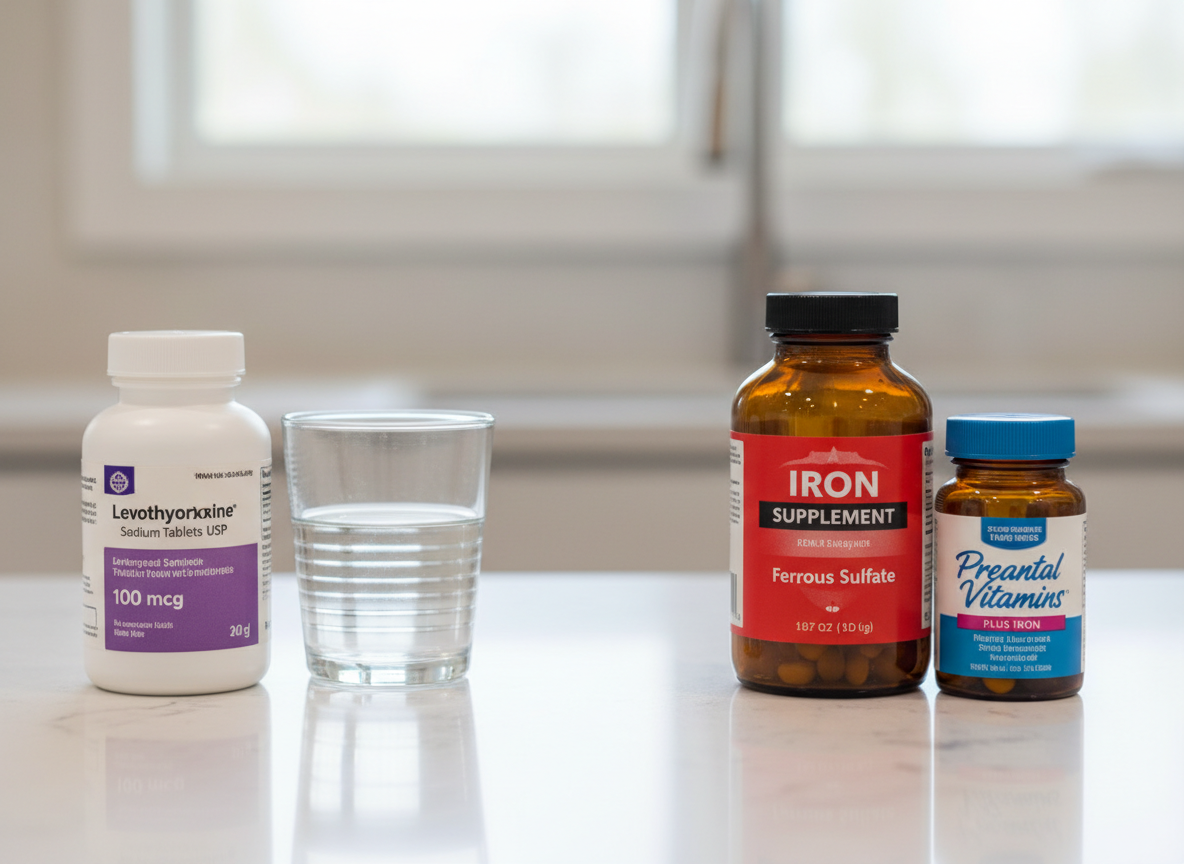
The label matters because many products hide the mineral that changed the routine
A prenatal can look simple on the outside while creating a major timing conflict on the inside.
How the interaction happens
Iron reduces levothyroxine absorption by binding it in the gut before the full dose is absorbed. When that happens every day, the blood tests can start to look as if the levothyroxine dose is too low even though the prescription never changed.
This is why patients sometimes feel frustrated after doing everything they were told to do. They took the iron because they needed it. They took levothyroxine because they needed it. The problem was not adherence, but that the routine stacked both products together.
Prenatal vitamins deserve special attention because they often contain both iron and calcium. That makes them doubly important to move out of the levothyroxine window.
Timing and spacing rules that matter
The simplest rule is still the most useful one: levothyroxine by itself first, iron later, and any prenatal or multivitamin checked for hidden minerals before it joins the routine.
| Scenario | Why it matters | Practical routine |
|---|---|---|
| Morning levothyroxine and lunchtime iron | This is often the easiest approach for standard once-daily iron | Take levothyroxine on waking and keep iron for lunch or early afternoon |
| Morning levothyroxine and evening prenatal | Useful when the prenatal contains iron or calcium | Keep the prenatal later in the day instead of pairing it with breakfast |
| Bedtime levothyroxine and daytime iron | Can work if the bedtime routine is already stable and food-free | Treat the gap the same way and avoid taking iron near the bedtime thyroid dose |
| Multiple daily iron doses | This makes the routine harder and sometimes needs planning with the prescriber | Protect the levothyroxine window first and then spread iron doses around meals as directed |

When symptoms overlap, the routine needs to be untangled before the diagnosis is blamed
Low iron and undertreated hypothyroidism can look alike, which is why timing review comes first.
Common mistakes and troubleshooting
Most iron problems show up because a patient tried to make the whole routine easier by taking everything together.
- Taking iron 30 to 60 minutes after levothyroxine and assuming breakfast timing solved the whole interaction.
- Forgetting that prenatal vitamins often contain iron even when the bottle is marketed around pregnancy support rather than iron specifically.
- Changing both the iron dose and the thyroid dose at the same time, which makes it harder to tell what actually moved the labs.
- Stopping iron on your own because the routine became inconvenient, even though the body still needs it for a separate reason.
Special situations to remember
- If fatigue, shortness of breath, or heavy periods were the reason iron was started, do not assume every symptom after that point belongs only to the thyroid. Low iron and undertreated hypothyroidism overlap heavily.
- If a prenatal contains both iron and calcium, treat it as a later-day product unless a clinician gave a different schedule for a specific reason.

If the schedule is fixed and the labs still drift, it is time for a more targeted review
Persistent symptoms or unstable numbers deserve a clinician-guided plan instead of more random timing experiments.
When to contact a healthcare provider
Timing errors are common, but a few situations deserve a direct call rather than more self-experimenting.
- Symptoms of anemia or undertreated hypothyroidism are significant enough that you are struggling with daily activity, palpitations, or shortness of breath.
- Pregnancy, postpartum recovery, infertility treatment, or heavy menstrual bleeding make the iron schedule medically important and hard to move casually.
- TSH remains unstable after the spacing was corrected or the levothyroxine dose keeps changing without a clear routine review.
- You were told to take iron more than once daily and cannot fit the schedule around levothyroxine without repeated conflicts.
Frequently Asked Questions
Can I take ferrous sulfate with levothyroxine?
Not in the same absorption window. Most patients should separate ferrous sulfate and levothyroxine by at least 4 hours.
Do prenatal vitamins count as iron supplements?
Often yes. Many prenatals contain iron, calcium, or both, which is why they so often interfere with a morning levothyroxine routine.
What if I accidentally took iron too soon after levothyroxine?
One mistake usually does not ruin treatment. Go back to the normal routine and focus on preventing the repeated pattern.
Can I stop iron and just keep levothyroxine steady?
Not unless the clinician managing the iron problem agrees. The better first move is usually schedule correction, not stopping a needed treatment.
Why do my symptoms still feel mixed after I fixed the timing?
Because low iron and low thyroid symptoms overlap. A follow-up with repeat labs is often needed to sort out which part of the picture improved and which part still needs work.
How long after fixing the spacing should labs be rechecked?
That depends on the clinical situation, but thyroid follow-up is commonly repeated after the routine has been stable long enough to show whether the timing fix worked.
Key Takeaways
- Iron is a classic levothyroxine absorber blocker and should usually be kept at least 4 hours away.
- Prenatal vitamins create many hidden conflicts because they often contain iron, calcium, or both.
- Fatigue after starting iron does not automatically mean the thyroid dose failed, but the timing must be reviewed.
- The goal is not to stop iron. The goal is to build a schedule that lets both treatments work.
Related Guides
- Levothyroxine Interactions: Complete FDA-Sourced Guide to Food, Drugs and Supplements
- Levothyroxine and the Empty Stomach Rule
- Best Time of Day to Take Levothyroxine
- Levothyroxine and Calcium Supplements
- Levothyroxine and Antacids
- Birth Control Pills and Levothyroxine
Sources
- FDA. Levothyroxine sodium tablets prescribing information. https://www.accessdata.fda.gov/drugsatfda_docs/label/2023/021116s027lbl.pdf
- American Thyroid Association. Hypothyroidism booklet. https://thyroid.org/wp-content/uploads/patients/brochures/Hypothyroidism_web_booklet.pdf
- Benvenga S, et al. When thyroid hormone replacement is ineffective: causes and practical management. https://pubmed.ncbi.nlm.nih.gov/28153426/