This interaction topic goes off course quickly because patients hear ‘cholesterol medicine’ and assume every cholesterol drug behaves the same way.
That is not how levothyroxine sees it. A nighttime statin is a very different thyroid question from a bile-acid sequestrant powder that can bind medications in the gut. The category matters more than the broad reason the drug was prescribed.
Here is the short answer: Most statins are not classic major levothyroxine absorption blockers, but bile-acid sequestrants such as cholestyramine, colestipol, and colesevelam can bind levothyroxine and require wide separation.
This guide explains which cholesterol medicines deserve the most caution, why the powder or binder class matters more than the generic word ‘cholesterol,’ and how to build a routine that protects both treatments.
The Quick Answer
| Situation | What it usually means | Better move |
|---|---|---|
| Statin taken at night | This is usually not the same high-priority spacing issue as calcium or iron | Keep the statin routine as prescribed and protect the levothyroxine window separately |
| Bile-acid sequestrant such as cholestyramine or colesevelam | This can bind levothyroxine and lower absorption | Separate widely and follow the thyroid labs after the cholesterol treatment starts |
| Several heart-health medicines started together | The routine can become hard to interpret | Review the full medication list instead of assuming the word ‘cholesterol’ tells you enough |
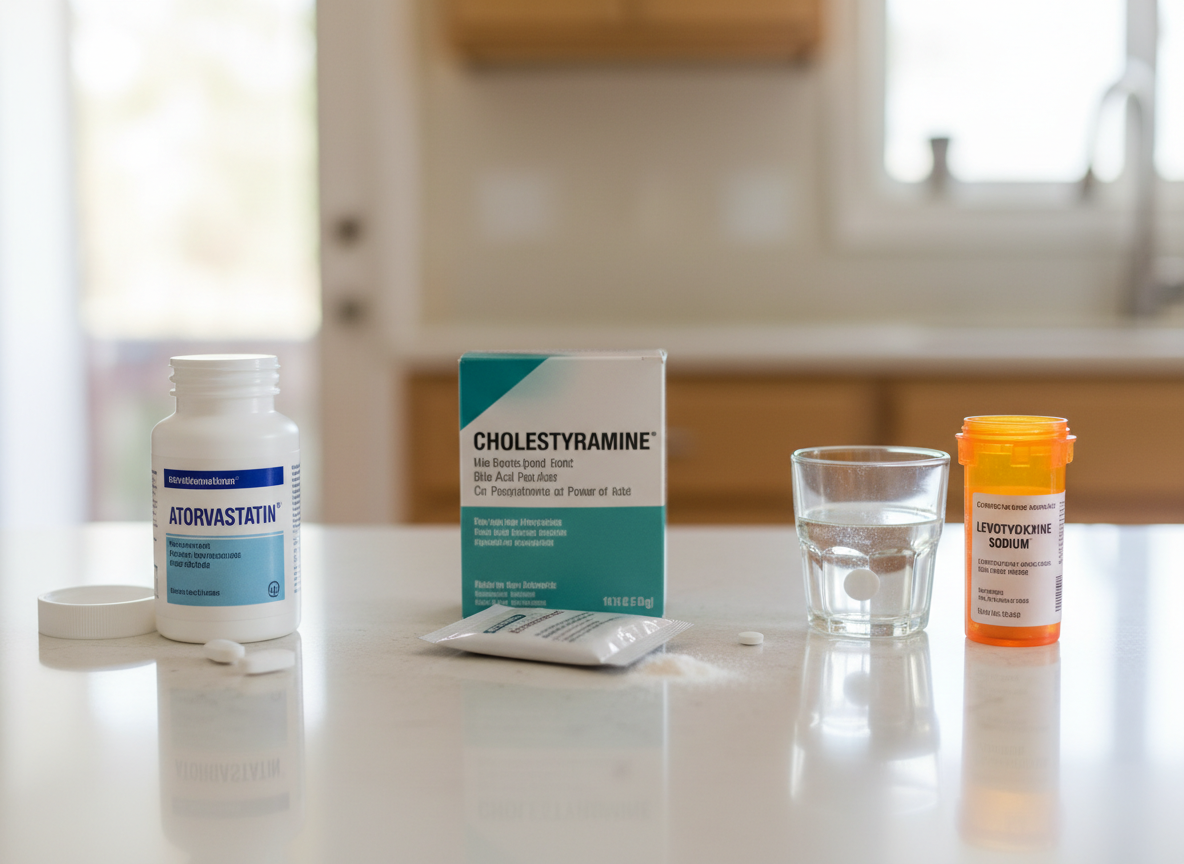
The word ‘cholesterol medicine’ is too broad to answer the thyroid question by itself
The exact drug class matters more than the reason it was prescribed.
What should patients know about Cholesterol Medications and Levothyroxine?
The first job in this topic is classification. Is the patient taking a statin, which is usually not the same kind of levothyroxine problem, or a bile-acid sequestrant, which is one of the clearer absorber blockers in practice?
Patients get confused because both categories can be prescribed for cholesterol, but the thyroid routine should not treat them as if they were interchangeable.
That is why a medication-list review matters so much here. Knowing the exact drug name often solves most of the question before timing is even discussed.
What the FDA label and clinical guidance say
Bile-acid sequestrants deserve the most caution because they can bind levothyroxine in the gut and reduce absorption. These are the products that belong closer to the calcium-and-iron style of thinking.
Statins, on the other hand, are not usually the main culprit when thyroid labs drift after a cholesterol treatment change. The bigger risk is assuming every cholesterol medicine works like cholestyramine when it does not.
The practical answer is usually to keep statins on their own usual schedule, identify any bile-acid binders explicitly, and protect the levothyroxine window from that group in particular.

The higher-risk problem usually appears when the cholesterol drug is a binder rather than a routine statin
Once the class is identified, the scheduling answer often becomes much clearer.
How the interaction happens
Bile-acid sequestrants work in the gut, and that is exactly why they can interfere with levothyroxine absorption. They can bind medications before those medications are fully absorbed.
This is different from statins, which do not usually create the same direct binding issue. That distinction is what makes the article clinically useful instead of vague.
If a patient only remembers the word ‘cholesterol medicine,’ the safest next step is to check the exact drug name before changing anything about the thyroid dose.
Timing and spacing rules that matter
The right schedule depends less on the reason the drug was prescribed and more on the class of cholesterol medicine actually being used.
| Scenario | Why it matters | Practical routine |
|---|---|---|
| Nighttime statin routine | Usually easier to keep separate from a morning thyroid dose | Keep the statin on its prescribed schedule and avoid inventing unnecessary spacing rules |
| Cholestyramine, colestipol, or colesevelam | Higher-priority absorber blocker | Use a wide separation and review labs after the binder enters the routine |
| Powder or binder mixed with meals | This can make the day more crowded | Protect the levothyroxine window first and fit the binder around the rest of the schedule |
| Several new heart medicines at once | The interaction picture gets more complex | Review the full list before assuming a single cholesterol medicine caused the thyroid drift |

A crowded heart-health routine can destabilize thyroid treatment even when every pill was prescribed for a good reason
The answer often starts with the full medication list rather than with one isolated bottle.
Common mistakes and troubleshooting
This topic usually goes wrong when the drug class is left vague.
- Calling everything a cholesterol pill and never checking whether the product is actually a bile-acid binder.
- Treating a statin as if it needs the same high-priority spacing rule as cholestyramine.
- Changing the levothyroxine dose before reviewing whether the cholesterol medicine that started was truly an absorption blocker.
- Forgetting that heart-health routines often include several other interaction-prone products at the same time, such as calcium or reflux treatment.
Special situations to remember
- Older adults are especially likely to have several concurrent morning medicines, which means a single new binder can destabilize an already crowded routine.
- If the patient takes both cholesterol binders and supplements such as calcium or fiber, the combined routine may matter more than any one product by itself.

When several medication changes happened together, a clinician-guided review is worth more than a guess
The most important question is often which class was added and how it changed the daily routine around levothyroxine.
When to contact a healthcare provider
Most patients can keep both therapies in the plan, but a few situations deserve a more deliberate review.
- You started a bile-acid sequestrant and thyroid labs changed afterward.
- You are not sure which cholesterol drug you take and the schedule is already crowded with several morning products.
- Repeated thyroid dose changes happened after a new cardiology routine began and no one reviewed the whole medication list.
- Symptoms, labs, and the medication schedule do not line up clearly enough to make a safe guess at home.
Frequently Asked Questions
Do statins interfere with levothyroxine the way calcium or iron do?
Usually no. The higher-priority concern in the cholesterol category is usually bile-acid sequestrants, not standard statins.
Which cholesterol medicines matter most for levothyroxine?
Cholestyramine, colestipol, and colesevelam deserve the most caution because they can bind medications in the gut.
Can I take my statin at night and levothyroxine in the morning?
That is often a practical and clean routine if those were already the prescribed schedules.
What if I only know that I take a cholesterol medicine?
Check the exact drug name before making changes. The class matters more than the broad reason it was prescribed.
Should I raise my thyroid dose if a cholesterol binder was started?
Not automatically. It is better to protect the timing first and review follow-up labs before changing the prescription.
Why did my thyroid routine become harder after my heart medicines changed?
Because cardiology regimens often add several products at once, and one or more of them may have crowded the levothyroxine window.
Key Takeaways
- Not every cholesterol medicine is the same levothyroxine question.
- Bile-acid sequestrants matter more than statins for direct absorption problems.
- Checking the exact drug name is the highest-value first step.
- A cleaner schedule is usually a better first response than a reflex thyroid dose change.
Related Guides
- Levothyroxine Interactions: Complete FDA-Sourced Guide to Food, Drugs and Supplements
- Levothyroxine and the Empty Stomach Rule
- Best Time of Day to Take Levothyroxine
- Complete Drug Interaction Reference
- Levothyroxine and Antacids
- How to Read Your Thyroid Lab Results
Sources
- FDA. Levothyroxine sodium tablets prescribing information. https://www.accessdata.fda.gov/drugsatfda_docs/label/2023/021116s027lbl.pdf
- American Thyroid Association. Hypothyroidism booklet. https://thyroid.org/wp-content/uploads/patients/brochures/Hypothyroidism_web_booklet.pdf
- Levothyroxine label interaction class information. https://www.accessdata.fda.gov/drugsatfda_docs/label/2012/202231s003lbl.pdf