You started levothyroxine, and now you are seeing more hair in the shower, on your brush, or on your pillow. That is scary. It is also one of the most misunderstood thyroid-medication problems.
Here is the short answer: hair loss on levothyroxine is usually not a sign that the medication itself is “poisoning” your hair. More often, it points to one of four things:
- your thyroid levels were off for a while before treatment started
- your dose is still too low or has gone too high
- you are in the early adjustment period, when temporary shedding can happen
- something else is driving the hair loss at the same time
According to DailyMed’s LEVOXYL labeling, partial hair loss can occur rarely during the first few months of therapy and is usually temporary. At the same time, NIDDK lists dry, thinning hair as a common symptom of hypothyroidism itself. That is why this issue is so confusing: the condition and the treatment can overlap.
In this guide, you will learn what hair loss on levothyroxine usually means, when it suggests a dose problem, what temporary shedding looks like, and when it is time to ask for lab work or a different formulation.

This is the moment most people start searching
Hair loss becomes urgent emotionally long before it becomes urgent medically, which is why the article has to separate temporary shedding, dose problems, and unrelated causes clearly.
What Does Hair Loss on Levothyroxine Usually Mean?
In most cases, hair loss on levothyroxine means the thyroid problem has not fully stabilized yet, not that the medication is fundamentally wrong for you.
According to NIDDK, hypothyroidism commonly causes dry, thinning hair. If your thyroid hormone was low for months before diagnosis, your hair follicles were already under stress before you ever swallowed the first tablet. Levothyroxine fixes the hormone problem, but hair cycles move slowly. Because of that lag, shedding can continue for weeks or months even after treatment starts.
That timing matters. Hair does not respond as fast as heart rate, energy, or constipation. A thyroid dose can change your lab numbers in weeks, but visible hair recovery often takes much longer.
The practical takeaway is simple: if shedding started right after treatment began, do not assume the medication is the enemy. First ask whether this is delayed fallout from untreated hypothyroidism, temporary early shedding, or a sign that the dose still needs work.
Can Levothyroxine Itself Cause Temporary Hair Shedding?
Yes, but it is usually short-lived.
DailyMed’s LEVOXYL labeling says partial hair loss may occur rarely during the first few months of therapy and is usually temporary. That pattern fits what many patients describe: shedding increases shortly after starting treatment or shortly after a meaningful dose change, then gradually settles down.
Why would that happen? Hair follicles are sensitive to abrupt hormonal shifts. If your body moves from a hypothyroid state toward a normal thyroid state, some follicles may reset into a new growth cycle. That can look worse before it looks better.
Temporary shedding is more likely to look like:
- diffuse thinning across the scalp, not bald patches
- more hair in the shower or brush for several weeks
- shedding that starts after beginning treatment or after a major dose change
- no major scalp rash, pain, or scarring
Temporary shedding is less likely to be the whole explanation if:
- it keeps getting worse beyond a few months
- your TSH remains abnormal
- you also have palpitations, tremor, anxiety, or heat intolerance
- you have fatigue, constipation, dry skin, and ongoing cold intolerance
- you see patchy hair loss, scalp scaling, or skin symptoms
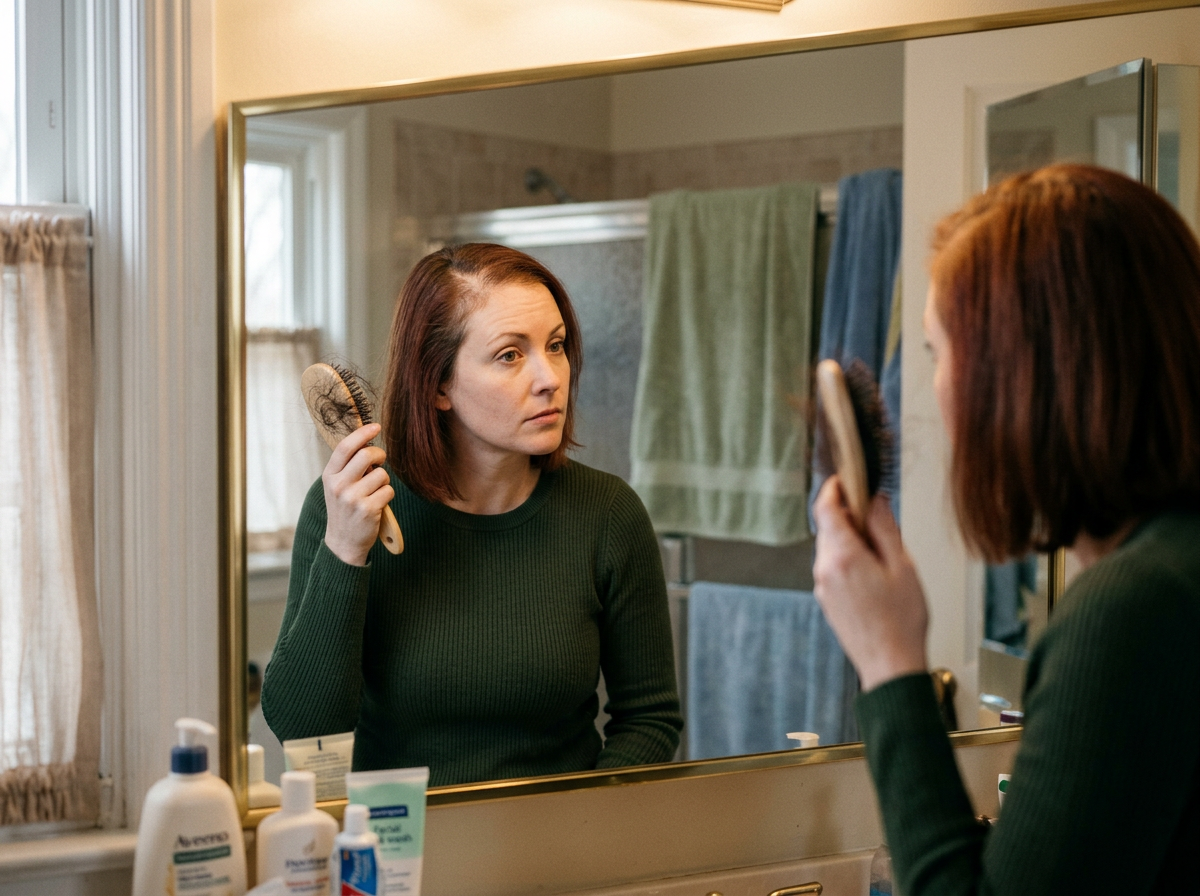
A visible shedding pattern still needs context
Diffuse shedding, patchy loss, scalp irritation, and the timing relative to treatment can point toward very different explanations even when the brush looks alarming either way.
When Does Hair Loss Suggest the Dose Is Too High?
Hair loss can happen when levothyroxine pushes you into over-replacement.
According to FDA and DailyMed labeling, adverse reactions to levothyroxine therapy are mainly signs of hyperthyroidism from excessive dosing. The same label lists hair loss among reported dermatologic reactions, alongside symptoms like palpitations, nervousness, sweating, diarrhea, and insomnia.
That does not mean every person with hair shedding is overmedicated. It means hair loss becomes more suspicious when it shows up with a classic “too much thyroid hormone” pattern.
Signs the dose may be too high include:
- heart palpitations
- fast pulse
- shakiness or tremor
- anxiety or feeling unusually wired
- sweating or heat intolerance
- loose stools
- insomnia
- unintentional weight loss
If your hair loss comes with several of those symptoms, the next step is not to stop levothyroxine on your own. The next step is to ask for repeat thyroid labs and a dose review.
For patients in this situation, Dose Adjustment and TSH Monitoring is often the most useful next read.
When Does Hair Loss Mean the Dose May Still Be Too Low?
This is the more common scenario.
NIDDK lists dry, thinning hair as a symptom of hypothyroidism. If your dose is still too low, or if you have only recently started treatment, your hair may keep acting like you are hypothyroid because, functionally, you still are.
Hair loss is more likely to reflect under-treatment when it appears with:
- persistent fatigue
- dry skin
- constipation
- feeling cold
- brain fog
- slower-than-expected improvement after starting treatment
This is especially important for people who expected immediate hair regrowth after starting levothyroxine. Hair recovery is usually delayed. If the dose is not yet fully optimized, the follicles may never get the stable signal they need to recover.
That is why hair loss should almost never be interpreted in isolation. The question is not just “am I shedding?” The real question is “what are my labs, what other symptoms do I have, and where am I in the treatment timeline?”
How Long Does It Usually Take for Hair to Improve?
Usually longer than people want.
Hair follicles cycle slowly. Even when thyroid levels normalize, hair may need several months to show visible improvement. Patients often feel better before their hair looks better.
A practical timeline looks like this:
| Time Since Starting or Adjusting Levothyroxine | What Hair Changes May Mean |
|---|---|
| First few weeks | Too early to judge regrowth; temporary shedding may still happen |
| 1-3 months | Early stabilization period; persistent heavy shedding deserves a lab review |
| 3-6 months | Many patients start seeing less shedding if thyroid levels are stable |
| 6+ months | Ongoing worsening should trigger a broader evaluation beyond thyroid alone |
If you are still losing significant hair after your TSH has been stable for several months, it is reasonable to look for other contributors instead of assuming the medication is still the main problem.
Could Something Else Be Causing the Hair Loss?
Yes. Often, yes.
Hair loss has a long differential. Thyroid disease is one cause, but it is not the only one. If your thyroid labs are in range and shedding is still significant, other common contributors include:
- iron deficiency
- recent illness or major stress
- postpartum shedding
- menopause or androgen-related hair thinning
- rapid weight loss
- scalp conditions
- autoimmune hair loss such as alopecia areata
- medication changes unrelated to levothyroxine
Hashimoto’s also raises the odds that another autoimmune problem is in the picture. If the shedding is patchy, abrupt, or associated with other autoimmune symptoms, that deserves a broader workup.
This is also why “I started levothyroxine and then noticed hair loss” does not automatically prove causation. Thyroid disease, low iron, stress, and medication timing often overlap.
Could a Formulation Change or Dye Sensitivity Be the Problem?
Sometimes, but this is usually a skin-reaction story more than a pure hair-loss story.
According to DailyMed labeling, hypersensitivity reactions reported with thyroid hormone products are generally reactions to inactive ingredients, not to levothyroxine itself. These reactions can include rash, itching, flushing, angioedema, and wheezing. Some tablet strengths also contain different dyes and fillers.
That matters if your story sounds like this:
- your pharmacy switched manufacturers
- the pill color changed
- you developed a rash, itching, or scalp irritation
- the hair issue started with other skin symptoms
In that situation, it may help to review the refill, confirm the manufacturer, and discuss whether the same manufacturer or a different formulation would make sense. That is more likely if you have had trouble after brand switches before.
If your refill recently changed, Switching Between Brands and Generics is the logical companion article.

When the refill changed, the hair-loss story may no longer be only about thyroid levels
A different manufacturer, new dye mix, or change in pill appearance is not proof, but it is a meaningful clue when scalp irritation or rash enters the picture alongside shedding.
What Should You Do if You Notice Hair Loss on Levothyroxine?
Do not panic, and do not stop the medication abruptly.
Use this checklist instead:
1. Look at the timeline
Did the shedding start before treatment, right after starting, after a dose increase, or months later? The pattern helps narrow the cause.
2. Check for dose-pattern symptoms
Palpitations, tremor, and insomnia push the story toward over-treatment. Fatigue, dry skin, and constipation push it toward under-treatment or incomplete recovery.
3. Review your last lab work
If your TSH has not been checked since starting or changing the dose, you are missing a critical piece of the puzzle.
4. Check your refill
Did the manufacturer or tablet color change? If yes, note the date and bring that information to your clinician or pharmacist.
5. Review your timing
If you are taking levothyroxine with food, coffee, calcium, iron, or antacids too closely, the real issue may be poor absorption rather than the dose on the label.
For many patients, Levothyroxine and the Empty Stomach Rule and the interaction guides are where the answer shows up.
When Should You Get Help Right Away?
Hair shedding alone is usually not an emergency. The concern changes if it comes with signs that the dose is pushing too hard on the heart or causing a broader reaction.
Contact a healthcare provider promptly if hair loss is paired with:
- chest pain
- new or severe palpitations
- shortness of breath
- fainting
- severe anxiety or tremor after a dose change
- facial swelling, hives, or wheezing
Those symptoms are not “just cosmetic.” They need medical follow-up.
For symptom-specific guidance, Heart Palpitations and Levothyroxine belongs in the same reading session.

Hair loss usually becomes solvable when the conversation widens beyond the medication bottle
The right follow-up often means reviewing the scalp pattern, thyroid labs, refill history, and other contributors like iron deficiency, stress, postpartum change, or autoimmune causes.
Frequently Asked Questions
Can levothyroxine cause hair loss?
Yes, it can happen rarely, especially early in treatment, and DailyMed’s LEVOXYL label says partial hair loss during the first few months is usually temporary. More often, though, the shedding reflects hypothyroidism itself or a dose that still needs adjustment.
Is hair loss on levothyroxine permanent?
Usually not. Temporary shedding after treatment starts often improves as thyroid levels stabilize. If hair loss keeps worsening despite stable labs, it is time to look for other causes too.
How do I know if my thyroid dose is causing the hair loss?
Look at the pattern. Hair loss with palpitations, anxiety, tremor, and insomnia points more toward too much thyroid hormone. Hair loss with fatigue, dry skin, constipation, and cold intolerance points more toward under-treatment or lingering hypothyroidism.
Should I stop levothyroxine if my hair is falling out?
No. Stopping suddenly can make the underlying thyroid problem worse. The safer move is to review the timing, refill history, symptoms, and thyroid labs with your healthcare provider.
How long does hair loss last after starting levothyroxine?
If the shedding is part of the early adjustment period, it often improves over the next several months. Hair recovery is slower than symptom recovery, so visible improvement may lag behind your lab improvement.
Key Takeaways
- Hair loss on levothyroxine is often a thyroid-control issue, not a simple medication allergy.
- DailyMed says partial hair loss can occur rarely in the first few months of therapy and is usually temporary.
- NIDDK lists dry, thinning hair as a common symptom of hypothyroidism itself, which means shedding can continue even after treatment starts.
- Hair loss with palpitations, tremor, anxiety, or insomnia raises concern that the dose may be too high.
- Hair loss with fatigue, dry skin, constipation, and cold intolerance raises concern that the dose may still be too low or recovery is incomplete.
- If the story does not fit your thyroid labs, look for other contributors such as iron deficiency, stress, postpartum shedding, or autoimmune hair loss.
Hair loss on levothyroxine is real, but it is rarely a simple yes-or-no medication reaction. Most of the time, it is a clue. The job is to figure out what the clue points to: temporary early shedding, under-treatment, over-treatment, poor absorption, a refill change, or a separate hair problem entirely. If you treat it like a signal instead of a verdict, you are much more likely to solve it.
Sources
- FDA. Levothyroxine Sodium Tablets prescribing information. https://www.accessdata.fda.gov/drugsatfda_docs/label/2023/021116s027lbl.pdf
- DailyMed. LEVOXYL (levothyroxine sodium tablets) label. https://dailymed.nlm.nih.gov/dailymed/getFile.cfm?setid=951c6e16-7251-42ed-ac19-d8367a6aee4f&type=pdf
- NIDDK. Hypothyroidism (Underactive Thyroid). https://www.niddk.nih.gov/health-information/endocrine-diseases/hypothyroidism
- NIDDK. Hashimoto’s Disease. https://www.niddk.nih.gov/health-information/endocrine-diseases/hashimotos-disease
- American Thyroid Association. Hypothyroidism. https://www.thyroid.org/hypothyroidism/