Most levothyroxine overdose searches start the same way: you look at the pill organizer, realize something is off, and your mind jumps straight to the worst-case scenario.
That reaction is understandable. It is also why this topic needs more nuance than most short medication guides give it.
Here is the short answer: one accidental extra levothyroxine dose is not the same thing as a dangerous overdose, but it should still be taken seriously in the right context. According to FDA labeling, the signs and symptoms of levothyroxine overdosage are signs of hyperthyroidism, including palpitations, chest pain, tremor, anxiety, sweating, diarrhea, insomnia, and fast heart rate. The same labeling also warns that symptoms may not appear for several days after ingestion. Poison Control makes the practical point even more clearly: people should call right away for guidance rather than waiting to see how bad things get.
That is why the real question is not just “did I take too much?” The real question is:
- was this one extra tablet, repeated extra doses, or a large ingestion?
- is the person an adult, a child, or someone with heart disease?
- are there only mild symptoms, or are there chest symptoms, fainting, or severe palpitations?
In this guide, you will learn what usually counts as levothyroxine overdose, which symptoms are most concerning, why symptoms can be delayed, what to do in the first few hours, and when Poison Control or the ER is the right next move.
The Quick Answer
The safest way to think about levothyroxine overdose is by scenario, not by panic.
| Situation | What it usually means | Best next step |
|---|---|---|
| One accidental extra dose in a healthy adult | Often not an immediate crisis, but still worth confirming next steps | Review exactly what happened and call your pharmacist or clinician if unsure |
| Several extra doses, a large one-time mistake, or an uncertain amount | More concerning because symptoms can build over time | Call Poison Control now: 1-800-222-1222 |
| A child may have taken levothyroxine | Always higher concern because dose relative to body size is much larger | Call Poison Control immediately |
| Chest pain, fainting, trouble breathing, severe palpitations, confusion, or collapse | This is no longer a home-monitoring situation | Get urgent or emergency medical care |
| “Overdose” symptoms that have been building for weeks | This may be chronic overtreatment rather than one acute event | Arrange a prompt dose and lab review |
The two most important takeaways are:
- Do not assume “I feel okay right now” means the risk is over.
- Do not assume one extra dose automatically means you are in immediate danger.
Both mistakes create problems in opposite directions.
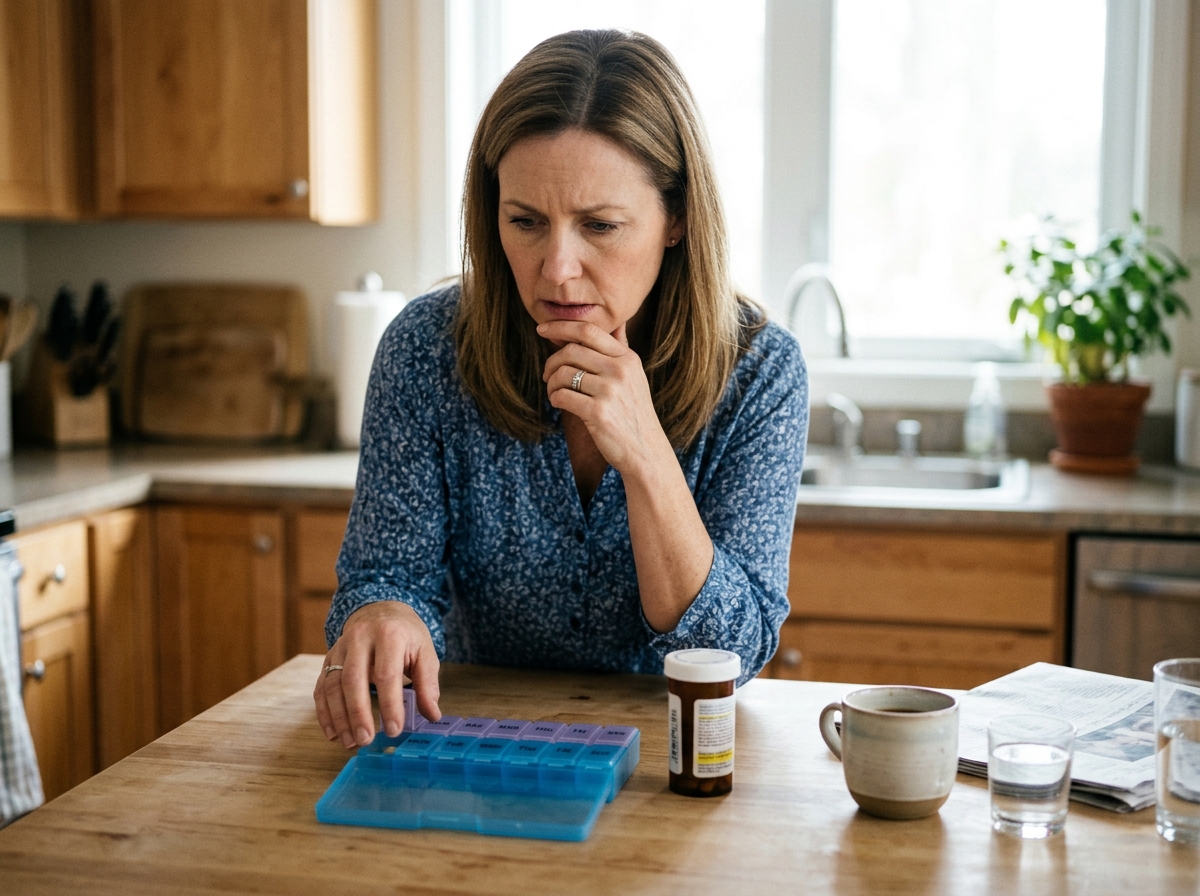
The first task is to figure out what actually happened, not to panic past the details
A real overdose workup starts with the tablet strength, the number of doses involved, and whether this was one mistake or a pattern over several days.
What Counts as Levothyroxine Overdose?
Patients use the word “overdose” to describe several very different situations:
- taking one extra tablet by mistake
- doubling the dose for two or three days because of a scheduling mix-up
- taking the wrong strength for several days
- a large one-time ingestion
- a child finding and swallowing tablets
- taking extra thyroid medication on purpose, including for weight loss
- living for weeks on a prescribed dose that is simply too high
Those are not equally risky, and they should not be handled as if they are.
The FDA label groups overdose symptoms under hyperthyroidism because excess levothyroxine pushes the body toward an overactive-thyroid state. But overdose risk depends on more than the tablet count. It also depends on:
- age
- heart history
- whether symptoms are already present
- whether this was acute or repeated
- whether the ingestion was certain or uncertain
Rachel’s story is the low-end version. She took her morning dose, forgot, and took it again an hour later. She is otherwise healthy, has no heart disease, and has no symptoms. That is a very different situation from a toddler swallowing tablets from a weekly pill organizer or from an older adult with atrial fibrillation taking double doses for four straight days.
That is why a good overdose article cannot stop at “symptoms include palpitations.” It has to tell you which type of overdose story you are actually in.
Why Symptoms Can Be Delayed
This is one of the most important parts of the article because it explains why people misread the danger in both directions.
Levothyroxine is a long-acting thyroid hormone. It does not behave like a short-acting stimulant or pain medication where trouble necessarily shows up right away. FDA labeling warns that signs and symptoms of overdosage may not be apparent for several days after ingestion.
That delayed pattern matters because patients often make one of two mistakes:
- “I feel normal right now, so I must be in the clear.”
- “I took one extra pill and need to go to the ER immediately.”
Neither assumption is reliable by itself.
A better way to think about it is this:
- a single extra dose in an otherwise healthy adult often does not trigger immediate dramatic symptoms
- a larger or repeated overdose may evolve over time, especially as the excess hormone continues to circulate and act on the heart and nervous system
This is one reason Poison Control is useful even when symptoms are mild or absent at first. The goal is not just to react to symptoms after they appear. The goal is to match the response to the likely risk.
What Symptoms Usually Suggest Too Much Levothyroxine?
According to FDA labeling, overdose symptoms generally look like hyperthyroidism. Common symptoms include:
- palpitations
- fast heart rate
- chest pain
- shortness of breath
- tremor
- nervousness
- irritability
- anxiety
- sweating
- heat intolerance
- headache
- diarrhea
- insomnia
In more serious cases, the label also describes:
- arrhythmias
- heart failure
- confusion or disorientation
- shock
- coma
That does not mean every person with one extra tablet is heading toward that list. It means that overdose risk becomes more concerning when the symptom pattern is clearly moving beyond “I accidentally duplicated today’s dose” into a real excess-thyroid picture.
| Symptom pattern | What it suggests | What to do |
|---|---|---|
| No symptoms after one accidental extra dose | Often lower immediate risk, but not automatically cleared | Confirm next steps with a pharmacist or clinician if uncertain |
| Palpitations, tremor, sweating, insomnia, anxiety | Excess thyroid effect is possible | Call Poison Control or a clinician for guidance, especially if more than one extra dose was taken |
| Chest pain, fainting, severe shortness of breath, severe palpitations | Higher-risk cardiovascular involvement | Seek urgent or emergency care |
| Symptoms that built up over weeks rather than hours | Chronic overtreatment may be the real issue | Arrange prompt labs and dose review |
If the main pattern is racing heart, shakiness, diarrhea, and insomnia, Heart Palpitations and Levothyroxine is the most relevant companion page.

A racing-heart pattern changes the situation fast
When tremor, pounding heartbeat, chest discomfort, or severe anxiety start showing up after extra doses, the question shifts from “Did I mess up?” to “How urgently do I need medical guidance?”
When Is One Extra Dose Different From a True Emergency?
This is where patients usually want the clearest answer.
In practical terms, one accidental extra dose is often lower risk than people fear, especially in an otherwise healthy adult with no heart disease and no symptoms. That is an inference from the drug’s long half-life and the fact that symptoms may be delayed rather than immediate. It is not blanket clearance for every patient.
One extra dose becomes less reassuring when:
- the person is older
- the person has atrial fibrillation, coronary disease, or another heart condition
- symptoms have already started
- the “one extra dose” may actually have happened more than once
- the strength was much higher than usual
Now compare that with clearly higher-risk situations:
Repeated extra doses
If you accidentally doubled up for several days, the problem is no longer just one mistaken morning. The risk of developing an excess-thyroid pattern is higher.
Large one-time ingestion
If the amount taken was clearly large, uncertain, or potentially intentional, the safest move is not to self-triage from memory. Call Poison Control.
Child exposure
This is a different category. A toddler swallowing “only a few pills” may still receive a much larger dose relative to body size than an adult. Poison Control should be contacted immediately.
Kevin’s story shows the middle ground. He missed that his pill organizer had already been filled and took double doses for three days. By day four he had tremor, poor sleep, and a pounding heartbeat. That is no longer the same as a single accidental duplicate dose. That is exactly the kind of story where direct triage matters.
What To Do Right Away if You Think Too Much Was Taken
The best first steps are practical and calm.
1. Figure out what actually happened
Before you guess, check:
- the tablet strength
- how many tablets may have been taken
- whether the usual daily dose had already been taken
- whether the exposure involved a child
- whether the mistake happened once or over several days
If you use a weekly pill organizer, compare it with the prescription bottle.
2. Do not keep taking more doses “just in case”
Once you realize there may have been an overdose or duplicate dose, stop guessing through the rest of the day. The immediate task is to clarify the exposure, not to improvise.
3. Call Poison Control for significant, uncertain, or child exposures
In the United States, call 1-800-222-1222. Poison Control is available 24/7 and can tell you whether home observation is reasonable or whether you need urgent evaluation.
This is especially important when:
- a child may have taken tablets
- the amount is uncertain
- more than one extra dose was taken
- symptoms are already present
- there is heart disease or another high-risk condition
4. Get urgent care for red-flag symptoms
Do not stay in phone-triage mode if the situation has clearly crossed into emergency symptoms. Go for urgent or emergency evaluation for:
- chest pain
- fainting
- sustained severe palpitations
- significant shortness of breath
- confusion
- collapse
5. Follow up on the dose and lab side afterward
Even when the immediate danger passes, the larger question still matters: was this a one-time mistake, or is the routine setup making future mistakes likely?

Possible child exposure should move you straight to Poison Control
A child does not need dramatic symptoms for the situation to matter. What looks like “only a few pills” to an adult can be a much larger dose relative to body size.
Children, Older Adults, and Heart Patients Need More Caution
Not every patient brings the same margin for error to an overdose situation.
Children
A child’s body size changes the equation. FDA labeling specifically notes that severe manifestations in children can include fever, hyperactivity, headache, tachycardia, arrhythmias, flushing, diarrhea, sweating, and seizures. Poison Control should be contacted immediately for any suspected child ingestion.
One of the easiest ways these exposures happen is a pill organizer left within reach. Unlike a child-resistant bottle, an organizer is essentially open access.
Older adults
Older adults are more vulnerable to cardiac effects from excess thyroid hormone. The same amount that produces jitters in a younger person can be much more consequential in someone with less cardiovascular reserve.
Patients with heart disease
This is the group that deserves the least casual reassurance. If there is a history of:
- atrial fibrillation
- coronary artery disease
- heart failure
- significant arrhythmia
then chest symptoms or sustained palpitations after an overdose situation should be taken more seriously.
Marilyn’s scenario is the high-risk version. She is 73, has a history of atrial fibrillation, and realizes she may have doubled her levothyroxine for two days because the new bottle was stored next to the old one. Even if her symptoms seem “just a little fluttery,” that is not the same as a healthy 30-year-old taking one extra tablet once.

High-risk patients need a lower threshold for urgent evaluation
Older adults and people with heart disease have less room for error once severe palpitations, chest symptoms, or repeated dosing mistakes enter the picture.
Chronic Overtreatment Can Look Like a Slow-Motion Overdose
Not every overdose story is acute.
Some patients search “levothyroxine overdose” because they feel overmedicated every day, not because they accidentally swallowed too many tablets this morning. In that setting, the real issue may be chronic overtreatment rather than an acute ingestion.
That pattern often looks like:
- ongoing palpitations
- persistent anxiety or feeling “amped up”
- tremor
- trouble sleeping
- heat intolerance
- unexplained weight loss
- frequent loose stools
FDA and DailyMed labeling both make the same basic point: most adverse reactions associated with levothyroxine are manifestations of excessive dosage. If symptoms have been building for weeks or months, the next step is usually not Poison Control. The next step is a lab and dose review.
That is also why this topic overlaps with Long-Term Safety of Levothyroxine. Chronic excess thyroid hormone is where the bone and heart risks start to matter more over time.
What Patients Often Get Wrong
These mistakes are common:
Mistake 1: Assuming no symptoms means no problem
Because levothyroxine symptoms can be delayed, “I feel fine right now” is not the same as “there is zero risk.”
Mistake 2: Treating every extra pill like a guaranteed emergency
This creates unnecessary panic and often skips the more useful middle step: clear triage based on the actual amount, the patient’s risk factors, and whether symptoms are present.
Mistake 3: Ignoring repeated dosing mistakes
Many patients focus only on dramatic one-time overdose scenarios, when the more relevant risk is that they have been taking the wrong amount for several days.
Mistake 4: Forgetting the setup problem
If the overdose happened because:
- two bottles were open at once
- a pill organizer was filled incorrectly
- a spouse also manages medications
- a new strength was mixed with an old one
then the post-event fix should include changing the system, not just surviving the day.
Mistake 5: Missing weight-loss misuse as a dangerous pattern
FDA labeling warns that thyroid hormones should not be used for obesity or weight loss. Larger doses, especially when combined with other weight-loss agents, can cause serious or life-threatening toxicity.
A Safer Checklist for the Future
Once the immediate concern is handled, prevention matters.
Use this checklist:
- keep only one active bottle open at a time
- separate old and new strengths
- label the pill organizer clearly
- store medication out of children’s reach
- avoid leaving tablets loose on a counter
- review dose changes in writing when a clinician adjusts the prescription
- recheck TSH after a clinically significant dose change
This is especially important for families where one person manages medications for more than one adult.
Frequently Asked Questions
What happens if I take two doses of levothyroxine in one day?
Often, one accidental double dose is not the same as a severe overdose, especially in an otherwise healthy adult. But it still deserves a careful review of the amount, your symptoms, and your risk factors.
How do I know if I overdosed on levothyroxine?
Symptoms usually resemble hyperthyroidism: palpitations, tremor, anxiety, sweating, diarrhea, and insomnia. More severe symptoms such as chest pain, fainting, confusion, or severe palpitations need urgent evaluation.
Should I call Poison Control even if I feel okay?
Yes, if the ingestion was large, uncertain, involved a child, involved repeated extra doses, or occurred in someone with significant heart disease. Symptoms may be delayed.
How long after taking too much levothyroxine do symptoms start?
They may not appear immediately. FDA labeling warns that signs and symptoms may not be apparent for several days after ingestion.
Should I skip the next dose if I took too much?
That depends on the exact situation. The safest answer is individualized guidance from Poison Control, your pharmacist, or your clinician rather than guessing.
Is chronic overtreatment the same thing as overdose?
Not exactly, but it can produce the same excess-thyroid symptom pattern over time. If symptoms have been building for weeks, dose review and lab testing are usually more relevant than acute poisoning management.
When should I go to the ER?
Go for urgent or emergency care for chest pain, fainting, significant shortness of breath, confusion, collapse, or severe sustained palpitations.
Key Takeaways
- One extra levothyroxine dose is not automatically the same as a dangerous overdose, but the context matters.
- Symptoms of too much levothyroxine usually look like hyperthyroidism: palpitations, tremor, anxiety, sweating, diarrhea, and insomnia.
- Symptoms can be delayed for several days, so “I feel fine right now” is not a full safety check.
- Children, older adults, and people with heart disease deserve lower thresholds for calling Poison Control or seeking urgent care.
- A slow-building “overdose” story is often chronic overtreatment and needs a dose and lab review, not just reassurance.
Sources
- FDA. Levothyroxine Sodium Tablets prescribing information. https://www.accessdata.fda.gov/drugsatfda_docs/label/2023/021116s027lbl.pdf
- Poison Control. Synthroid (Levothyroxine). https://www.poison.org/articles/synthroid-levothyroxine
- DailyMed. LEVOXYL prescribing information. https://dailymed.nlm.nih.gov/dailymed/fda/fdaDrugXsl.cfm?setid=951c6e16-7251-42ed-ac19-d8367a6aee4f&type=display